


Page 270 - Fluid Mechanics and Thermodynamics of Turbomachinery
P. 270
Radial Flow Gas Turbines 251
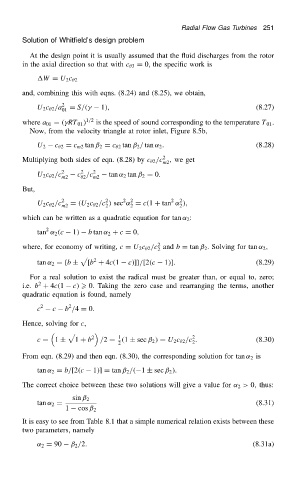
Solution of Whitfield’s design problem
At the design point it is usually assumed that the fluid discharges from the rotor
in the axial direction so that with c 3 D 0, the specific work is
W D U 2 c 2
and, combining this with eqns. (8.24) and (8.25), we obtain,
2
U 2 c 2 /a 01 D S/.
1/, (8.27)
where a 01 D .
RT 01 / 1/2 is the speed of sound corresponding to the temperature T 01 .
Now, from the velocity triangle at rotor inlet, Figure 8.5b,
c 2 D c m2 tan ˇ 2 D c 2 tan ˇ 2 / tan ˛ 2 . (8.28)
U 2
2
Multiplying both sides of eqn. (8.28) by c 2 /c , we get
m2
2
U 2 c 2 /c 2 c /c 2 tan ˛ 2 tan ˇ 2 D 0.
m2 2 m2
But,
2
2
2 2
2
U 2 c 2 /c 2 D .U 2 c 2 /c / sec ˛ D c.1 C tan ˛ /,
m2 2 2 2
which can be written as a quadratic equation for tan ˛ 2 :
2
tan ˛ 2 .c 1/ b tan ˛ 2 C c D 0,
2
where, for economy of writing, c D U 2 c 2 /c and b D tan ˇ 2 . Solving for tan ˛ 2 ,
2
p
2
tan ˛ 2 Dfb š [b C 4c.1 c/]g/[2.c 1/]. (8.29)
For a real solution to exist the radical must be greater than, or equal to, zero;
2
i.e. b C 4c.1 c/ > 0. Taking the zero case and rearranging the terms, another
quadratic equation is found, namely
2
c 2 c b /4 D 0.
Hence, solving for c,
p
1
2
c D 1 š 1 C b 2 /2 D .1 š sec ˇ 2 / D U 2 c 2 /c . (8.30)
2 2
From eqn. (8.29) and then eqn. (8.30), the corresponding solution for tan ˛ 2 is
tan ˛ 2 D b/[2.c 1/] D tan ˇ 2 /. 1 š sec ˇ 2 /.
The correct choice between these two solutions will give a value for ˛ 2 > 0, thus:
sin ˇ 2
tan ˛ 2 D (8.31)
1 cos ˇ 2
It is easy to see from Table 8.1 that a simple numerical relation exists between these
two parameters, namely
˛ 2 D 90 ˇ 2 /2. (8.31a)

