


Page 280 - Fluid Mechanics and Thermodynamics of Turbomachinery
P. 280
Radial Flow Gas Turbines 261
P 01
h
P 1
01
P 02 ¢ rel
1
02¢rel P 02rel
02rel
(1) b 2 ¢ P 2
w 2 ¢
2
2¢
2s
(2) P 3
b 2, opt 3
(b)
3s
w 2
3s¢
3ss
(a)
s
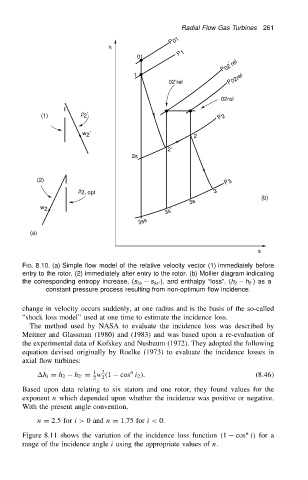
FIG. 8.10. (a) Simple flow model of the relative velocity vector (1) immediately before
entry to the rotor, (2) immediately after entry to the rotor. (b) Mollier diagram indicating
h 2 0)asa
the corresponding entropy increase, (s 3s s 3s 0), and enthalpy “loss”, (h 2
constant pressure process resulting from non-optimum flow incidence.
change in velocity occurs suddenly, at one radius and is the basis of the so-called
“shock loss model” used at one time to estimate the incidence loss.
The method used by NASA to evaluate the incidence loss was described by
Meitner and Glassman (1980) and (1983) and was based upon a re-evaluation of
the experimental data of Kofskey and Nusbaum (1972). They adopted the following
equation devised originally by Roelke (1973) to evaluate the incidence losses in
axial flow turbines:
1
2
n
h i D h 2 h 2 D w .1 cos i 2 /. (8.46/
0
2 2
Based upon data relating to six stators and one rotor, they found values for the
exponent n which depended upon whether the incidence was positive or negative.
With the present angle convention,
n D 2.5 for i> 0 and n D 1.75 for i< 0.
n
Figure 8.11 shows the variation of the incidence loss function .1 cos i/ for a
range of the incidence angle i using the appropriate values of n.

