


Page 305 - Fluid Mechanics and Thermodynamics of Turbomachinery
P. 305
286 Fluid Mechanics, Thermodynamics of Turbomachinery
                          Sizing the penstock

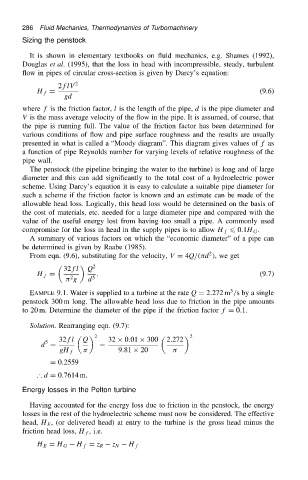
                            It is shown in elementary textbooks on fluid mechanics, e.g. Shames (1992),
                          Douglas et al. (1995), that the loss in head with incompressible, steady, turbulent
                          flow in pipes of circular cross-section is given by Darcy’s equation:
                                    2flV 2
                              H f D                                                        (9.6)
                                     gd
                          where f is the friction factor, l is the length of the pipe, d is the pipe diameter and
                          V is the mass average velocity of the flow in the pipe. It is assumed, of course, that
                          the pipe is running full. The value of the friction factor has been determined for
                          various conditions of flow and pipe surface roughness and the results are usually
                          presented in what is called a “Moody diagram”. This diagram gives values of f as
                          a function of pipe Reynolds number for varying levels of relative roughness of the
                          pipe wall.
                            The penstock (the pipeline bringing the water to the turbine) is long and of large
                          diameter and this can add significantly to the total cost of a hydroelectric power
                          scheme. Using Darcy’s equation it is easy to calculate a suitable pipe diameter for
                          such a scheme if the friction factor is known and an estimate can be made of the
                          allowable head loss. Logically, this head loss would be determined on the basis of
                          the cost of materials, etc. needed for a large diameter pipe and compared with the
                          value of the useful energy lost from having too small a pipe. A commonly used
                          compromise for the loss in head in the supply pipes is to allow H f 6 0.1H G .
                            A summary of various factors on which the “economic diameter” of a pipe can
                          be determined is given by Raabe (1985).
                                                                             2
                            From eqn. (9.6), substituting for the velocity, V D 4Q/. d /, we get
                                             2
                                     32fl   Q
                              H f D           .                                            (9.7)
                                       2
                                        g   d 5
                                                                                   3
                            EAMPLE 9.1. Water is supplied to a turbine at the rate Q D 2.272 m /s by a single
                          penstock 300 m long. The allowable head loss due to friction in the pipe amounts
                          to 20 m. Determine the diameter of the pipe if the friction factor f D 0.1.
                            Solution. Rearranging eqn. (9.7):
                                              2                         2
                                    32fl  Q       32 ð 0.01 ð 300  2.272
                                5
                               d D             D
                                    gH f            9.81 ð 20
                                  D 0.2559
                              ∴ d D 0.7614 m.
                          Energy losses in the Pelton turbine

                            Having accounted for the energy loss due to friction in the penstock, the energy
                          losses in the rest of the hydroelectric scheme must now be considered. The effective
                          head, H E , (or delivered head) at entry to the turbine is the gross head minus the
                          friction head loss, H f , i.e.

                              H E D H G  H f D z R  z N  H f

