


Page 310 - Fluid Mechanics and Thermodynamics of Turbomachinery
P. 310
Hydraulic Turbines  291


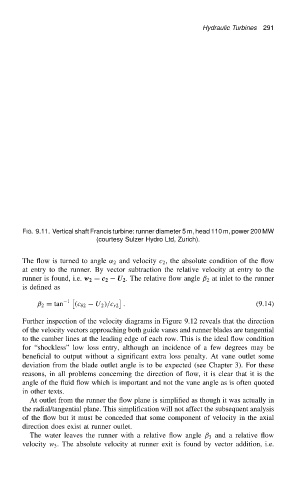
                          FIG. 9.11. Vertical shaft Francis turbine: runner diameter 5 m, head 110 m, power 200 MW
                                              (courtesy Sulzer Hydro Ltd, Zurich).


                          The flow is turned to angle ˛ 2 and velocity c 2 , the absolute condition of the flow
                          at entry to the runner. By vector subtraction the relative velocity at entry to the
                          runner is found, i.e. w 2 D c 2  U 2 . The relative flow angle ˇ 2 at inlet to the runner
                          is defined as
                                      1
                              ˇ 2 D tan  .c  2  U 2 //c r2 .                              (9.14)
                          Further inspection of the velocity diagrams in Figure 9.12 reveals that the direction
                          of the velocity vectors approaching both guide vanes and runner blades are tangential
                          to the camber lines at the leading edge of each row. This is the ideal flow condition
                          for “shockless” low loss entry, although an incidence of a few degrees may be
                          beneficial to output without a significant extra loss penalty. At vane outlet some
                          deviation from the blade outlet angle is to be expected (see Chapter 3). For these
                          reasons, in all problems concerning the direction of flow, it is clear that it is the
                          angle of the fluid flow which is important and not the vane angle as is often quoted
                          in other texts.
                            At outlet from the runner the flow plane is simplified as though it was actually in
                          the radial/tangential plane. This simplification will not affect the subsequent analysis
                          of the flow but it must be conceded that some component of velocity in the axial
                          direction does exist at runner outlet.
                            The water leaves the runner with a relative flow angle ˇ 3 and a relative flow
                          velocity w 3 . The absolute velocity at runner exit is found by vector addition, i.e.

