


Page 306 - Fluid Mechanics and Thermodynamics of Turbomachinery
P. 306
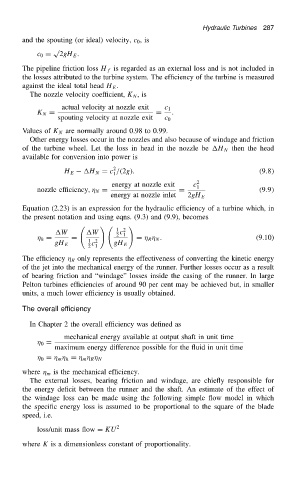
Hydraulic Turbines 287
and the spouting (or ideal) velocity, c 0 ,is
p
c 0 D 2gH E .
The pipeline friction loss H f is regarded as an external loss and is not included in
the losses attributed to the turbine system. The efficiency of the turbine is measured
against the ideal total head H E .
The nozzle velocity coefficient, K N ,is
actual velocity at nozzle exit c 1
K N D D .
spouting velocity at nozzle exit c 0
Values of K N are normally around 0.98 to 0.99.
Other energy losses occur in the nozzles and also because of windage and friction
of the turbine wheel. Let the loss in head in the nozzle be H N then the head
available for conversion into power is
2
H N D c /.2g/. .9.8/
H E
1
energy at nozzle exit c 2 1
nozzle efficiency, N D D .9.9/
energy at nozzle inlet 2gH E
Equation (2.23) is an expression for the hydraulic efficiency of a turbine which, in
the present notation and using eqns. (9.3) and (9.9), becomes
! !
W W 1 2
c
2 1
h D D D R N . (9.10)
1 2
gH E c gH E
2 1
The efficiency R only represents the effectiveness of converting the kinetic energy
of the jet into the mechanical energy of the runner. Further losses occur as a result
of bearing friction and “windage” losses inside the casing of the runner. In large
Pelton turbines efficiencies of around 90 per cent may be achieved but, in smaller
units, a much lower efficiency is usually obtained.
The overall efficiency
In Chapter 2 the overall efficiency was defined as
mechanical energy available at output shaft in unit time
0 D
maximum energy difference possible for the fluid in unit time
0 D m h D m R N
where m is the mechanical efficiency.
The external losses, bearing friction and windage, are chiefly responsible for
the energy deficit between the runner and the shaft. An estimate of the effect of
the windage loss can be made using the following simple flow model in which
the specific energy loss is assumed to be proportional to the square of the blade
speed, i.e.
loss/unit mass flow D KU 2
where K is a dimensionless constant of proportionality.

