


Page 321 - Fluid Mechanics and Thermodynamics of Turbomachinery
P. 321
302 Fluid Mechanics, Thermodynamics of Turbomachinery
in general, made so that their shafts are orientated vertically, lessening the problem
of cavitation occurrence.
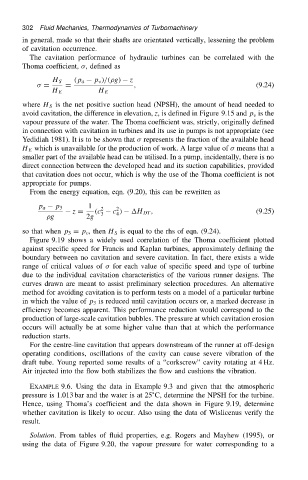
The cavitation performance of hydraulic turbines can be correlated with the
Thoma coefficient, , defined as
H S .p a p v //. g/ z
D D , (9.24)
H E H E
where H S is the net positive suction head (NPSH), the amount of head needed to
avoid cavitation, the difference in elevation, z, is defined in Figure 9.15 and p v is the
vapour pressure of the water. The Thoma coefficient was, strictly, originally defined
in connection with cavitation in turbines and its use in pumps is not appropriate (see
Yedidiah 1981). It is to be shown that represents the fraction of the available head
H E which is unavailable for the production of work. A large value of means that a
smaller part of the available head can be utilised. In a pump, incidentally, there is no
direct connection between the developed head and its suction capabilities, provided
that cavitation does not occur, which is why the use of the Thoma coefficient is not
appropriate for pumps.
From the energy equation, eqn. (9.20), this can be rewritten as
1
p a p 3 2 2
z D .c 3 c / H DT , (9.25)
4
g 2g
so that when p 3 D p v , then H S is equal to the rhs of eqn. (9.24).
Figure 9.19 shows a widely used correlation of the Thoma coefficient plotted
against specific speed for Francis and Kaplan turbines, approximately defining the
boundary between no cavitation and severe cavitation. In fact, there exists a wide
range of critical values of for each value of specific speed and type of turbine
due to the individual cavitation characteristics of the various runner designs. The
curves drawn are meant to assist preliminary selection procedures. An alternative
method for avoiding cavitation is to perform tests on a model of a particular turbine
in which the value of p 3 is reduced until cavitation occurs or, a marked decrease in
efficiency becomes apparent. This performance reduction would correspond to the
production of large-scale cavitation bubbles. The pressure at which cavitation erosion
occurs will actually be at some higher value than that at which the performance
reduction starts.
For the centre-line cavitation that appears downstream of the runner at off-design
operating conditions, oscillations of the cavity can cause severe vibration of the
draft tube. Young reported some results of a “corkscrew” cavity rotating at 4 Hz.
Air injected into the flow both stabilizes the flow and cushions the vibration.
EXAMPLE 9.6. Using the data in Example 9.3 and given that the atmospheric
pressure is 1.013 bar and the water is at 25 ° C, determine the NPSH for the turbine.
Hence, using Thoma’s coefficient and the data shown in Figure 9.19, determine
whether cavitation is likely to occur. Also using the data of Wislicenus verify the
result.
Solution. From tables of fluid properties, e.g. Rogers and Mayhew (1995), or
using the data of Figure 9.20, the vapour pressure for water corresponding to a

