


Page 128 - Fluid Power Engineering
P. 128
102    Cha pte r  F o u r


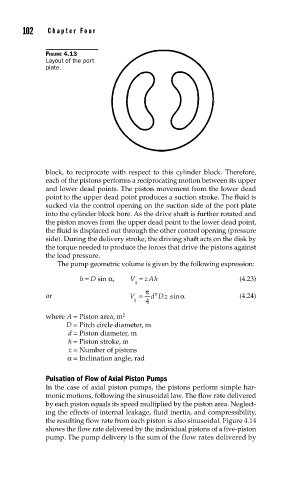
               FIGURE 4.13
               Layout of the port
               plate.


               block, to reciprocate with respect to this cylinder block. Therefore,
               each of the pistons performs a reciprocating motion between its upper
               and lower dead points. The piston movement from the lower dead
               point to the upper dead point produces a suction stroke. The fluid is
               sucked via the control opening on the suction side of the port plate
               into the cylinder block bore. As the drive shaft is further rotated and
               the piston moves from the upper dead point to the lower dead point,
               the fluid is displaced out through the other control opening (pressure
               side). During the delivery stroke, the driving shaft acts on the disk by
               the torque needed to produce the forces that drive the pistons against
               the load pressure.
                   The pump geometric volume is given by the following expression:

                         h = D sin α,     V = z A h                 (4.23)
                                        g
                                           π
                                             2
               or                     V =   d Dz sin α              (4.24)
                                        g  4
               where  A = Piston area, m 2
                     D = Pitch circle diameter, m
                      d = Piston diameter, m
                      h = Piston stroke, m
                      z = Number of pistons
                     α = Inclination angle, rad

               Pulsation of Flow of Axial Piston Pumps
               In the case of axial piston pumps, the pistons perform simple har-
               monic motions, following the sinusoidal law. The flow rate delivered
               by each piston equals its speed multiplied by the piston area. Neglect-
               ing the effects of internal leakage, fluid inertia, and compressibility,
               the resulting flow rate from each piston is also sinusoidal. Figure 4.14
               shows the flow rate delivered by the individual pistons of a five-piston
               pump. The pump delivery is the sum of the flow rates delivered by

