


Page 123 - Fluid Power Engineering
P. 123
Hydraulic Pumps      97


          4.4  Cavitation in Displacement Pumps
               The cavitation characteristics of a pump describe the effect of input
               pressure on the pump flow rate. The reduction of the pump inlet
               pressure to values less than the vapor pressure leads to the evapora-
               tion or boiling of oil. The fluid flow to the pump inlet becomes a
               mixture of liquid, liberated gases, and vapors. At zero or very low
               exit pressure, when the pump is bypassed for example, the vapors
               do not condensate and the vapor cavities do not collapse. But during
               normal operating conditions, the pump is loaded by great load pres-
               sures. The vapor cavities collapse due to the rapid condensation of
               vapors when transmitted to the high-pressure zone. Therefore, the
               net flow rate of the pump decreases. Generally, a 1% increase in the
               vapor volume in the oil-vapor flow reduces the pump volumetric
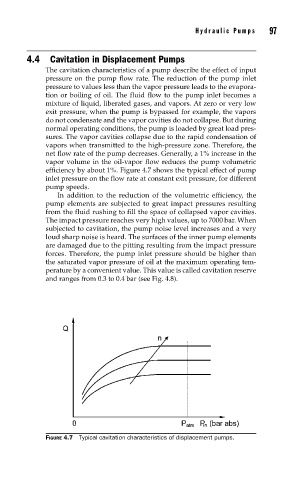
               efficiency by about 1%. Figure 4.7 shows the typical effect of pump
               inlet pressure on the flow rate at constant exit pressure, for different
               pump speeds.
                   In addition to the reduction of the volumetric efficiency, the
               pump elements are subjected to great impact pressures resulting
               from the fluid rushing to fill the space of collapsed vapor cavities.
               The impact pressure reaches very high values, up to 7000 bar. When
               subjected to cavitation, the pump noise level increases and a very
               loud sharp noise is heard. The surfaces of the inner pump elements
               are damaged due to the pitting resulting from the impact pressure
               forces. Therefore, the pump inlet pressure should be higher than
               the saturated vapor pressure of oil at the maximum operating tem-
               perature by a convenient value. This value is called cavitation reserve
               and ranges from 0.3 to 0.4 bar (see Fig. 4.8).


               FIGURE 4.7  Typical cavitation characteristics of displacement pumps.

