


Page 120 - Fluid Power Engineering
P. 120
94    Cha pte r  F o u r


          4.3 Real Pump Analysis
               The hydraulic power delivered to the fluid by the real pumps is less
               than the input mechanical power due to the volumetric, friction, and
               hydraulic losses. The actual pump flow rate, Q, is less than the theo-
               retical flow, Q , mainly due to:
                           t
                    •  Internal leakage
                    •  Pump cavitation and aeration
                    •  Fluid compressibility
                    •  Partial filling of the pump due to fluid inertia

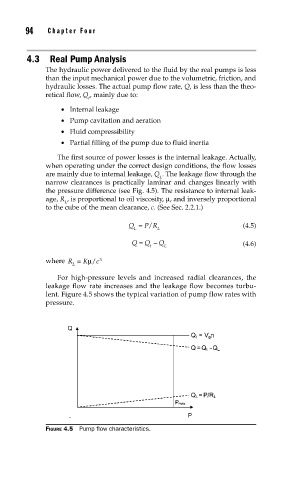
                   The first source of power losses is the internal leakage. Actually,
               when operating under the correct design conditions, the flow losses
               are mainly due to internal leakage, Q . The leakage flow through the
                                               L
               narrow clearances is practically laminar and changes linearly with
               the pressure difference (see Fig. 4.5). The resistance to internal leak-
               age, R , is proportional to oil viscosity, μ, and inversely proportional
                     L
               to the cube of the mean clearance, c. (See Sec. 2.2.1.)
                                      Q = /                          (4.5)
                                          P R
                                        L     L
                                       Q = Q −  Q L                  (4.6)
                                            t
                          K
               where  R =μ/  c 3
                       L
                   For high-pressure levels and increased radial clearances, the
               leakage flow rate increases and the leakage flow becomes turbu-
               lent. Figure 4.5 shows the typical variation of pump flow rates with
               pressure.


               FIGURE 4.5  Pump flow characteristics.

