


Page 133 - Fluid Catalytic Cracking Handbook
P. 133
108  Fluid Catalytic Cracking Handbook

 of the E-cat is directly related to the alumina content of the fresh
 catalyst. When changing catalyst grades, the alumina level of the E-
 cat is often used to determine the percent of new catalyst in the unit.

 Sodium (Na)

  The sodium in the E-cat is the sum of sodium added with the feed
 and sodium on the fresh catalyst. A number of catalyst suppliers report
 sodium as soda (Na 2O). Sodium deactivates the catalyst acid sites and
 causes collapse of the zeolite crystal structure. Sodium can also reduce
 the gasoline octane, as discussed earlier,

 Nickel (Ni), Vanadium (V), Iron (Fe), Copper (Cu)

  These metals, when deposited on the E-cat catalyst, increase coke
 and gas-making tendencies of the catalyst. They cause dehydrogenation
 reactions, which increase hydrogen production and decrease gasoline
 yields. Vanadium can also destroy the zeolite activity and thus lead
 to lower conversion. The deleterious effects of these metals also
 depend on the regenerator temperature: the rate of deactivation of a
 metal-laden catalyst increases as the regenerator temperature increases.
  These contaminates originate largely from the heavy (1,050+ °F/
 566+ °C), high-molecular weight fraction of the FCC feed. The
 quantity of these metals on the E-cat is determined by their levels in
 the feedstock and the catalyst addition rate. Essentially, all these metals
 in the feed are deposited on the catalyst. Most of the iron on the E-
 cat comes from metal scale from piping and from the fresh catalyst.
  Metals content of the E-cat can be determined fairly accurately by
 conducting a metals balance around the unit:
  Metals in - Metals out = Metals Accumulated


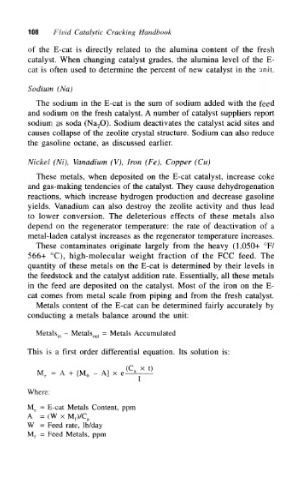
 This is a first order differential equation. Its solution is:

  M e = A + [M 0 - A] x e- Ca  X  ^

 Where:

 M e = E-cat Metals Content, ppm
 A = (W x M f)/C a
 W = Feed rate, Ib/day
 M f = Feed Metals, ppm

