


Page 131 - Fluid Catalytic Cracking Handbook
P. 131
106   Fluid Catalytic Cracking Handbook

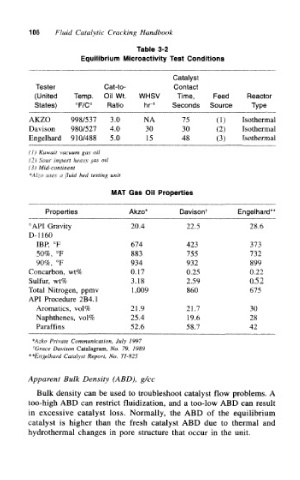
                            Table 3-2
             Equilibrium Microactivity Test Conditions

                                      Catalyst
  Tester           Cat-to-            Contact
  (United   Temp.  Oil Wt.   WHSV      Time,    Feed     Reactor
  States)   °F/C°   Ratio     hr 1   Seconds   Source     Type

 AKZO      998/537   3.0      NA        75       (1)    Isothermal
 Davisoe   980/527   4.0      30        30       (2)    Isothermal
 Engelhard  910/488  5.0      15        48       (3)    Isothermal

 (}) Kuwait vacuum gas oil
 (2) Sour import heavy gas oil
 (3) Mid-continent
 *Alzo uses a fluid bed testing unit

                     MAT Gas Oil Properties

    Properties            Akzo*        Davison*        Engelhard**
 °API Gravity             20.4           22.5             28.6
 D-1160
  IBP, °F                  674           423              373
  50%, °F                  883           755              732
  90%, °F                 934            932              899
 Conearbon, wt%           0.17           0.25             0.22
 Sulfur, wt%               3.18          2.59             0.52
 Total Nitrogen, ppmv      1,009         860              675
 API Procedure 2B4.1
  Aromatics, vol%         21.9           21.7             30
  Naphthenes, vol%        25.4           19.6             28
  Paraffins               52.6           58.7             42
 *Azko Private Communication, July 1997
 f
 Grace Davison Catalagram, No. 79, 1989
 **Engelhard Catalyst Report, No. Tl-825

 Apparent Bulk Density (ABD), g/cc
  Bulk density can be used to troubleshoot catalyst flow problems. A
 too-high ABD can restrict fluidization, and a too-low ABD can result
 in excessive catalyst loss. Normally, the ABD of the equilibrium
 catalyst is higher than the fresh catalyst ABD due to thermal and
 hydrothermal changes in pore structure that occur in the unit.

