


Page 151 - Fluid Catalytic Cracking Handbook
P. 151
126  Fluid Catalytic Cracking Handbook

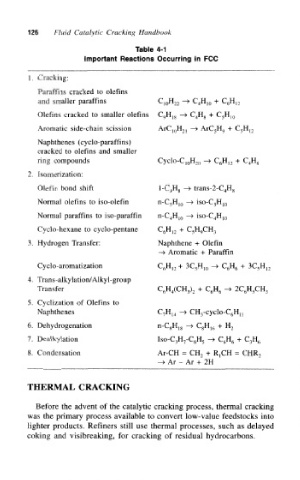
                            Table 4-1
              Important Reactions Occurring in FCC

 1. Cracking:
  Paraffins cracked to olefins
  and smaller paraffins

  Olefins cracked to smaller olefins  C 9H l8 -> C 4H 8 + C 5H 10
  Aromatic side-chain scission    ArC 10H 21  ArC 5H 9  C SH 1
  Naphthenes (cyclo-paraffins)
  cracked to olefins and smaller
  ring compounds                  Cyclo-C 1oH 20 -> C 6H 12  C 4H 8
 2. Isomerization:

  Olefin bond shift               1-C 4H 8 -^ trans-2-C 4H 8
  Normal olefins to iso-olefin    n-C 5H 10 — > iso-C 5H 10
  Normal paraffins to iso-paraffin  n-C 4H 10  iso-C 4H lo

  Cyclo-hexane to cyclo-pentane   C 6H 12 + C 5H 9CH 3
 3. Hydrogen Transfer:            Naphthene + Olefin
                                  -» Aromatic + Paraffin
  Cyclo-aromatization

 4. Trans-alkylation/Alkyl-group
  Transfer                                    C 6H 6  2C 6H 5CH 3

 5. Cyclization of Olefins to
  Naphthenes                      C 7H 14 -^ CH 3-cyclo-C 6H ii
 6. Dehydrogenation               n-C 8H 18 ~^  C 8 16  + H 2
                                              H
 7. Dealkylation                  lso-C 3H 7-C 6H 5 -» C 6H 6 -\. C 3H 6
                                                        C 3H 6
 8. Condensation                  Ar-C 3H == CH 2 + R,CH = CHR 2
                                   v AT  Ar + 2H
                                   7  jT\I

 THERMAL CRACKING

  Before the advent of the catalytic cracking process, thermal cracking
 was the primary process available to convert low-value feedstocks into
 lighter products. Refiners still use thermal processes, such as delayed
 coking and visibreaking, for cracking of residual hydrocarbons.

