


Page 152 - Fluid Catalytic Cracking Handbook
P. 152
Chemistry of FCC Reactions   127

  Thermal cracking is a function of temperature and time. The reaction
 occurs when hydrocarbons in the absence of a catalyst are exposed to high
 temperatures in the range of 800°F to 1,200°F (425°C to 650°C).
  The initial step in the chemistry of thermal cracking is the formation
 of free radicals. They are formed upon splitting the C-C bond. A free
 radical is an uncharged molecule with an unpaired electron. The
 rupturing produces two uncharged species that share a pair of elec-
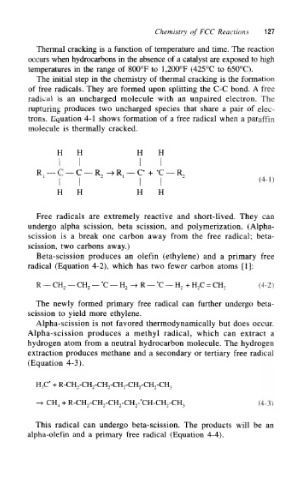
 trons. Equation 4-1 shows formation of a free radical when a paraffin
 molecule is thermally cracked.


              R 2 V "D  f*  I  */"*  t>
                 IV,,  7 IV  V- T  V- '  .IV
             |                           '                   (4-0
       H     H              H     H


  Free radicals are extremely reactive and short-lived. They can
 undergo alpha scission, beta scission, and polymerization. (Alpha-
 scission is a break one carbon away from the free radical; beta-
 scission, two carbons away.)
  Beta-scission produces an olefin (ethylene) and a primary free
 radical (Equation 4-2), which has two fewer carbon atoms [1]:

                                                             i
                                                              1
  J\  """"' V.'..il.^ —~ VvlT'} "•"*— V-, —  Lisy ""' " °~~~ Vx  S~M.-y T IT'iV--- ~™ V_-ilo  \T" "jiii. )
  The newly formed primary free radical can further undergo beta-
 scission to yield more ethylene.
  Alpha-scission is not favored thermodynamicaily but does occur.
 Alpha-scission produces a methyl radical, which can extract a
 hydrogen atom from a neutral hydrocarbon molecule. The hydrogen
 extraction produces methane and a secondary or tertiary free radical
 (Equation 4-3).


                                                             (4-3)
  -» CH 4 + R-CH2-CH 2-CH 2-CH 2-'CH-CH 2-CH 3

  This radical can undergo beta-scission. The products will be an
 alpha-olefin and a primary free radical (Equation 4-4).

