


Page 157 - Fluid Catalytic Cracking Handbook
P. 157
132  Fluid Catalytic Cracking Handbook

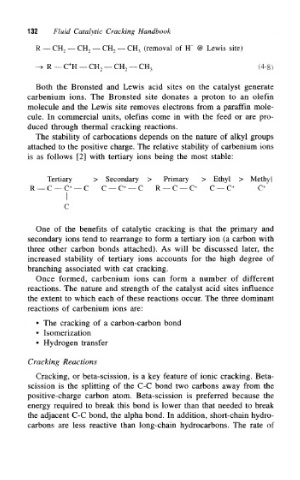
  R — CH 2 -— CH 2 — CH 2 — CH 3 (removal of H~ @ Lewis site)

          +
  _» R _ c H — CH 2 — CH 2 — CH 3                           (4-8}
  Both the Bronsted and Lewis acid sites on the catalyst generate
 carbenium ions. The Bronsted site donates a proton to an olefin
 molecule and the Lewis site removes electrons from a paraffin mole-
 cule. In commercial units, olefins come in with the feed or are pro-
 duced through thermal cracking reactions.
  The stability of carbocations depends on the nature of alkyl groups
 attached to the positive charge. The relative stability of carbenium ions
 is as follows [2] with tertiary ions being the most stable:

     Tertiary    > Secondary >     Primary   > Ethyl > Methyl
     C ~ C +  P    P   P+    P   R    P   P +  P    P +     P*
 R .  '"•"""" V--  ""  V.-  V_^  \*s  V~"  V-"'  JLX.  V-'  V_--  V--  *—•  V,,'
         c


  One of the benefits of catalytic cracking is that the primary and
 secondary ions tend to rearrange to form a tertiary ion (a carbon with
 three other carbon bonds attached). As will be discussed later, the
 increased stability of tertiary ions accounts for the high degree of
 branching associated with cat cracking.
  Once formed, carbenium ions can form a number of different
 reactions. The nature and strength of the catalyst acid sites influence
 the extent to which each of these reactions occur. The three dominant
 reactions of carbenium ions are:

  * The cracking of a carbon-carbon bond
  * Isomerization
  * Hydrogen transfer

 Cracking Reactions

  Cracking, or beta-scission, is a key feature of ionic cracking. Beta-
 scission is the splitting of the C-C bond two carbons away from the
 positive-charge carbon atom. Beta-scission is preferred because the
 energy required to break this bond is lower than that needed to break
 the adjacent C-C bond, the alpha bond. In addition, short-chain hydro-
 carbons are less reactive than long-chain hydrocarbons. The rate of

