


Page 158 - Fluid Catalytic Cracking Handbook
P. 158
Chemistry of FCC Reactions  133

 the cracking reactions decreases with decreasing chain length. With
 short chains, it is not possible to form stable carbenium ions.
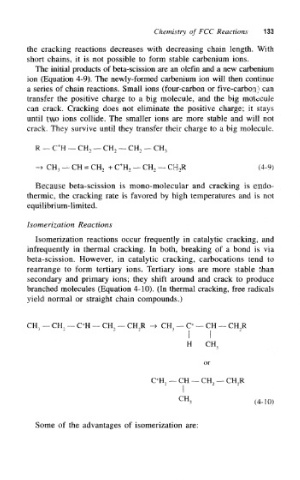
  The initial products of beta-scission are an olefin and a new carbenium
 ion (Equation 4-9). The newly-formed carbenium ion will then continue
 a series of chain reactions. Small ions (four-carbon or five-carbon) can
 transfer the positive charge to a big molecule, and the big molecule
 can crack. Cracking does not eliminate the positive charge; it stays
 until two ions collide. The smaller ions are more stable and will not
 crack, They survive until they transfer their charge to a big molecule,

       i+
   R _ r "H   CH    PH — PH       CH
   IV. "  " V,' 1 1  V*' 1. !••->  V--' 1 !••)  V--J. .I') "  \.~^ I to
                         +
  -* CH 3 — CH = CH 2 + C H 2 — CH 2 — CH 2R                 (4-9)
  Because beta-scission is mono-molecular and cracking is endo-
 thermic, the cracking rate is favored by high temperatures and is not
 equilibrium-limited.

 Isomerization Reactions

  Isomerization reactions occur frequently in catalytic cracking, and
 infrequently in thermal cracking. In both, breaking of a bond is via
 beta-scission. However, in catalytic cracking, carbocations tend to
 rearrange to form tertiary ions. Tertiary ions are more stable than
 secondary and primary ions; they shift around and crack to produce
 branched molecules (Equation 4-10). (In thermal cracking, free radicals
 yield normal or straight chain compounds.)


 CH 3 — CH, -— C+H — CH, — CH 2R -» CH 3 — C+ — CH — CH 2R

                                          H    CR

                                               or

                                        CH — CH 2 — CH 2R


                                                            (4-10)

  Some of the advantages of isomerization are:

