


Page 154 - Fluid Catalytic Cracking Handbook
P. 154
Chemistry of FCC Reactions   129

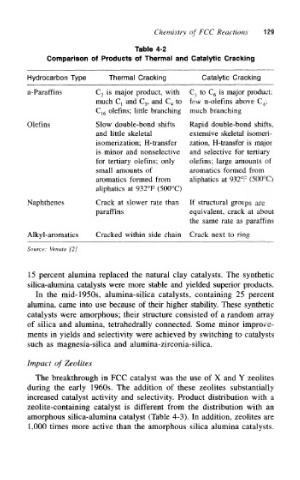
                            Table 4-2
     Comparison of Products of Thermal and Catalytic Cracking

 Hydrocarbon Type    Thermal Cracking         Catalytic Cracking

 n-Paraffms       C 2 is major product, with C 3 to C 6 is major product;
                  much C 3 and C 3, and C 4 to few n-olefins above C 4;
                  C 16 olefins; little branching  much branching
 Olefins          Slow double-bond shifts  Rapid double-bond shifts,
                  and little skeletal     extensive skeletal isomeri-
                  isomerization; H-transfer  zation, H-transfer is major
                  is minor and nonselective  and selective for tertiary
                  for tertiary olefins; only  olefins; large amounts of
                  small amounts of        aromatics formed from
                  aromatics formed from   aliphatics at 932°F (500°O
                  aliphatics at 932°F (500°C)
 Naphthenes       Crack at slower rate than  If structural groups are
                  paraffins               equivalent, crack at about
                                          the same rate as paraffins
 Alkyl-aromatics  Cracked within side chain Crack next to ring

 Source: Venuto [2]


 15 percent alumina replaced the natural clay catalysts. The synthetic
 silica-alumina catalysts were more stable and yielded superior products.
  In the mid-1950s, alumina-silica catalysts, containing 25 percent
 alumina, came into use because of their higher stability. These synthetic
 catalysts were amorphous; their structure consisted of a random array
 of silica and alumina, tetrahedrally connected. Some minor improve-
 ments in yields and selectivity were achieved by switching to catalysts
 such as magnesia-silica and alumina-zirconia-silica.

 Impact of Zeolites

  The breakthrough in FCC catalyst was the use of X and Y zeolites
 during the early 1960s. The addition of these zeolites substantially
 increased catalyst activity and selectivity. Product distribution with a
 zeolite-containing catalyst is different from the distribution with an
 amorphous silica-alumina catalyst (Table 4-3). In addition, zeolites are
 1,000 times more active than the amorphous silica alumina catalysts.

