


Page 233 - Fluid Catalytic Cracking Handbook
P. 233
Products and Economics   201

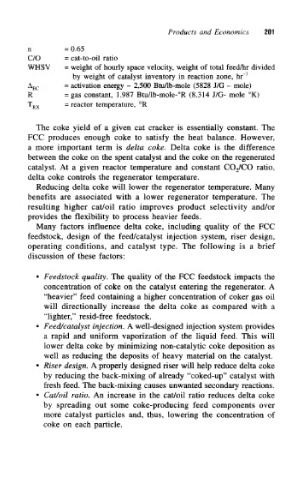
 n        = 0.65
 C/O      = cat-to-oil ratio
 WHS V    = weight of hourly space velocity, weight of total feed/hr divided
            by weight of catalyst inventory in reaction zone, hr -1
          = activation energy ~ 2,500 Btu/lb-mole (5828 J/G - mole)
 A EC
 R        = gas constant, 1.987 Btu/lb-mole-°R (8.314 J/G- mole °K)
          = reactor temperature, °R
 T RX
  The coke yield of a given cat cracker is essentially constant. The
 FCC produces enough coke to satisfy the heat balance. However,
 a more important term is delta coke. Delta coke is the difference
 between the coke on the spent catalyst and the coke on the regenerated
 catalyst. At a given reactor temperature and constant CO 2/CO ratio,
 delta coke controls the regenerator temperature.
  Reducing delta coke will lower the regenerator temperature. Many
 benefits are associated with a lower regenerator temperature. The
 resulting higher cat/oil ratio improves product selectivity and/or
 provides the flexibility to process heavier feeds.
  Many factors influence delta coke, including quality of the FCC
 feedstock, design of the feed/catalyst injection system, riser design,
 operating conditions, and catalyst type. The following is a brief
 discussion of these factors:

  * Feedstock quality. The quality of the FCC feedstock impacts the
    concentration of coke on the catalyst entering the regenerator. A
    "heavier" feed containing a higher concentration of coker gas oil
    will directionally increase the delta coke as compared with a
    "lighter," resid-free feedstock.
  * Feed/catalyst injection. A well-designed injection system provides
    a rapid and uniform vaporization of the liquid feed. This will
    lower delta coke by minimizing non-catalytic coke deposition as
    well as reducing the deposits of heavy material on the catalyst.
  • Riser design. A properly designed riser will help reduce delta coke
    by reducing the back-mixing of already "coked-up" catalyst with
    fresh feed. The back-mixing causes unwanted secondary reactions.
  • Cat/oil ratio. An increase in the cat/oil ratio reduces delta coke
    by spreading out some coke-producing feed components over
    more catalyst particles and, thus, lowering the concentration of
    coke on each particle.

