


Page 231 - Fluid Catalytic Cracking Handbook
P. 231
Products and Economics   199

  DO is the lowest priced product and the goal is to reduce its yield,
 The DO's yield largely depends on the quality of the feedstock and
 the conversion level. Naphthenic and aromatic feedstocks tend to yield
 more bottoms than paraffinic feedstocks. If the conversion is in the
 low- to mid-70's, increasing catalyst-to-oil ratio or using a catalyst
 with an active matrix can reduce slurry yield. Raising conversion
 reduces bottoms yield. If the conversion is in the 80's, little more can
 be done to reduce bottoms yields.

 Decant Oil Quality

  DO properties vary greatly depending on the feedstock quality and
 operating conditions.
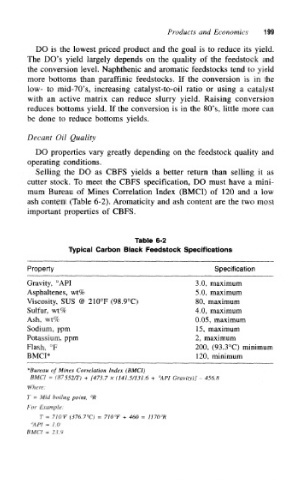
  Selling the DO as CBFS yields a better return than selling it as
 cutter stock. To meet the CBFS specification, DO must have a mini-
 mum Bureau of Mines Correlation Index (BMCI) of 120 and a low
 ash content (Table 6-2). Aromaticity and ash content are the two most
 important properties of CBFS.


                            Table 6-2
           Typical Carbon Black Feedstock Specifications

 Property                                        Specification
 Gravity, °API                              3.0, maximum
 Asphaltenes, wt%                           5.0, maximum
 Viscosity, SUS @ 210°F (98.9°C)            80, maximum
 Sulfur, wt%                                4.0, maximum
 Ash, wt%                                   0.05, maximum
 Sodium, ppm                                15, maximum
 Potassium, ppm                             2, maximum
 Flash, °F                                  200, (93.3°C) minimum
 BMCI*                                      120, minimum

 *Bureau of Mines Correlation Index (BMCI)
 BMCI = (87,552/T) + [473.7 x (141.5/131.6 + °AP1 Gravity)] - 456.8
 Where:
 T = Mid boiling point, °R
 For Example:
   T = 7!0°F (376.7°C) = 7JO°F + 460 = 1I70°R
 "API = 1.0
 BMCI = 23.9

