


Page 227 - Fluid Catalytic Cracking Handbook
P. 227
Products and Economics   195

 (text continued from page 190)
  • Increase in the catalyst activity and hydrogen transfer properties
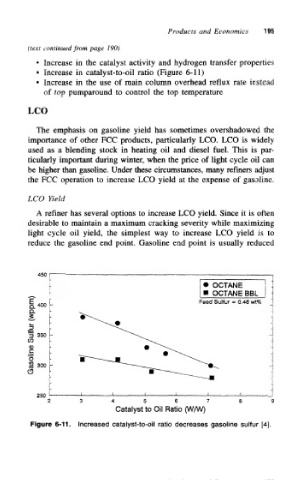
  • Increase in catalyst-to-oil ratio (Figure 6-11)
  • Increase in the use of main column overhead reflux rate instead
    of top pumparound to control the top temperature

 LCO

  The emphasis on gasoline yield has sometimes overshadowed the
 importance of other FCC products, particularly LCO. LCO is widely
 used as a blending stock in heating oil and diesel fuel. This is par-
 ticularly important during winter, when the price of light cycle oil can
 be higher than gasoline. Under these circumstances, many refiners adjust
 the FCC operation to increase LCO yield at the expense of gasoline.

 LCO Yield

  A refiner has several options to increase LCO yield. Since it is often
 desirable to maintain a maximum cracking severity while maximizing
 light cycle oil yield, the simplest way to increase LCO yield is to
 reduce the gasoline end point. Gasoline end point is usually reduced


   450
                                                OCTANE
                                                OCTANE BBL
                                             Feed Sulfur = 0,46 wt%  j
 f.400 (-
 t
 •5  F
 "3 350
 w
 £P
 c
  300
      !
      r

  250
                      4       5       6        7
                       Catalyst to Oil Ratio (W/W)
 Figure 6-11, Increased catalyst-to-oil ratio decreases gasoline sulfur [4],

