


Page 228 - Fluid Catalytic Cracking Handbook
P. 228
196  Fluid Catalytic Cracking Handbook

 by lowering the top temperature on the main column by increasing
 the top pumparound or the top reflux rate.
  The LCD distillation range is typically 430°F to 67()°F (221°C to
 354°C) ASTM. Undercutting the gasoline end point drops the heavy end
 of the gasoline fraction to be withdrawn with LCO. This affects only the
 apparent conversion and does not cause changes in the flow rate of other
 products. Reducing the gasoline end point usually increases the octane
 because of the lower-octane components in the heavy end of gasoline.
  A better method of increasing LCO yield is through better frac-
 tionation upstream. The removal of the fraction under 650°F from the
 feed requires better stripping. The total refinery yield of diesel will
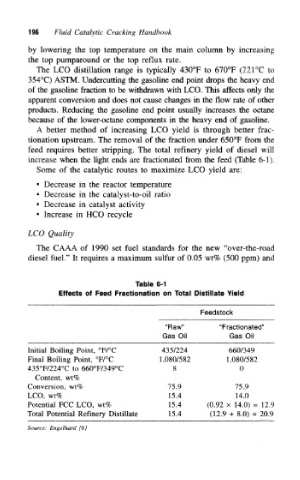
 increase when the light ends are fractionated from the feed (Table 6-1).
  Some of the catalytic routes to maximize LCO yield are:
  » Decrease in the reactor temperature
  * Decrease in the catalyst-to-oil ratio
  « Decrease in catalyst activity
  • Increase in HCO recycle

 LCO Quality

  The CAAA of 1990 set fuel standards for the new "over-the-road
 diesel fuel." It requires a maximum sulfur of 0.05 wt% (500 ppm) and


                            Table 6-1
        Effects of Feed Fractionation on Total Distillate Yield

                                             Feedstock

                                    "Raw"         "Fractionated"
                                   Gas Oil           Gas Oil
 Initial Boiling Point, °F/°C      435/224          660/349
 Final Boiling Point, °F/°C       1,080/582         1,080/582
 435°F/224°C to 660°F/349°C           8                0
  Content, wt%
 Conversion, wt%                    75.9              75.9
 LCO, wt%                            15.4             14.0
 Potential FCC LCO, wt%              15.4      (0.92 x 14.0) = 12.9
 Total Potential Refinery Distillate  15.4     (12.9 + 8.0) = 20.,9
 Source: Engelhard [6]

