


Page 232 - Fluid Catalytic Cracking Handbook
P. 232
200   Fluid Catalytic Cracking Handbook

  BMC! is a function of gravity and midpoint temperature. To achieve
 a BMCI of 120, the DO's °API gravity should not exceed 2.0. °API
 gravity is a rough indication of aromaticity; the lower the gravity, the
 higher the aromaticity.
  The ash content of the DO is affected by the reactor cyclone's
 performance and catalyst physical properties. To meet the CBFS' ash
 requirement (maximum of 0.05 wt%), DO product may need to be
 filtered for the removal of the catalyst fines.
 Coke


  In a cat cracker, a portion of the feed, mostly from secondary
 cracking and polymerization reactions, is deposited on the catalyst as
 coke. Coke formation is a necessary byproduct of the FCC operation;
 the heat released from burning coke in the regenerator supplies the
 heat for the reaction.
  The coke structure and the chemistry of its formation are difficult
 to define. However, coke in FCC comes from at least four sources:

  • Catalytic coke is a byproduct of the cracking of FCC feed to
    lighter products. Its yield is a function of conversion, catalyst
    type, and hydrocarbon/catalyst residence time in the reactor.
  • Contaminant coke is produced by catalytic activity of metals such
    as nickel, vanadium, and by deactivation of the catalyst caused
    by organic nitrogen.
  « Feed residue coke is the small portion of the (non-residue) feed
    that is directly deposited on the catalyst. This coke comes from
    the very heavy fraction of the feed and its yield is predicted by
    the Conradson or Ramsbottom carbon tests.
  • Catalyst circulation coke is a "hydrogen-rich" coke from the
    reactor-stripper. Efficiency of catalyst stripping and catalyst pore
    size distribution affect the amount of hydrocarbons carried over
    into the regenerator.
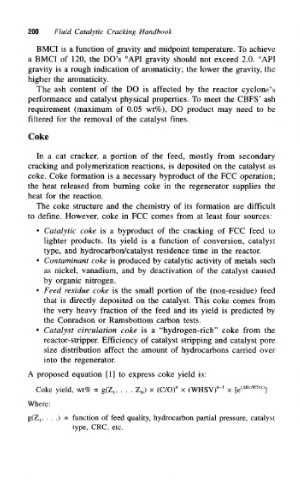
 A proposed equation [1] to express coke yield is:

                                      n          n s   (ABc/RTrx)
  Coke yield, wt% = g(Z,, . . . Z N) x (C/O)  x (WHSV) ~  x [ e  ]
 Where:
 g(Z,, . , .) = function of feed quality, hydrocarbon partial pressure, catalyst
           type,    ,          etc.

