


Page 265 - Fluid mechanics, heat transfer, and mass transfer
P. 265
CONVECTIVE HEAT TRANSFER BASICS
            246
                                                                   . For what type of fluids Prandtl numbers are of the order
            9.1.1  Heat Transfer Coefficients
                                                                     of 0.01 or less?
               . What is Newton’s law of cooling?                    & For liquid metals.
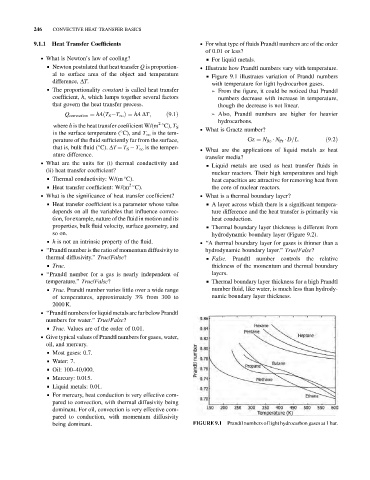
                 & Newton postulated that heat transfer Q is proportion-  . Illustrate how Prandtl numbers vary with temperature.
                  al to surface area of the object and temperature
                                                                     & Figure 9.1 illustrates variation of Prandtl numbers
                  difference, DT.
                                                                       with temperature for light hydrocarbon gases.
                 & The proportionality constant is called heat transfer
                                                                       ➢ From the figure, it could be noticed that Prandtl
                  coefficient, h, which lumps together several factors    numbers decrease with increase in temperature,
                  that govern the heat transfer process.                 though the decrease is not linear.
                      Q convection ¼ hAðT S  T 1 Þ¼ hA DT;  ð9:1Þ      ➢ Also, Prandtl numbers are higher for heavier
                                                                         hydrocarbons.
                                                     2
                   where h is the heat transfer coefficient W/(m C), T S
                                                                   . What is Graetz number?

                   is the surface temperature ( C), and T 1 is the tem-
                   perature of the fluid sufficiently far from the surface,          Gz ¼ N Re   N Pr   D=L:   ð9:2Þ

                   that is, bulk fluid ( C). DT ¼ T S   T 1 is the temper-
                                                                   . What are the applications of liquid metals as heat
                   ature difference.
                                                                     transfer media?
               . What are the units for (i) thermal conductivity and
                                                                     & Liquid metals are used as heat transfer fluids in
                (ii) heat transfer coefficient?
                                                                       nuclear reactors. Their high temperatures and high

                 & Thermal conductivity: W/(m C).
                                                                       heat capacities are attractive for removing heat from
                                            2
                 & Heat transfer coefficient: W/(m C).                  the core of nuclear reactors.
               . What is the significance of heat transfer coefficient?  . What is a thermal boundary layer?
                 & Heat transfer coefficient is a parameter whose value  & A layer across which there is a significant tempera-
                  depends on all the variables that influence convec-   ture difference and the heat transfer is primarily via
                  tion, for example, nature of the fluid in motion and its  heat conduction.
                  properties, bulk fluid velocity, surface geometry, and  & Thermal boundary layer thickness is different from
                  so on.                                               hydrodynamic boundary layer (Figure 9.2).
                 & h is not an intrinsic property of the fluid.     . ‘‘A thermal boundary layer for gases is thinner than a
               . ‘‘Prandtl number is the ratio of momentum diffusivity to  hydrodynamic boundary layer.’’ True/False?
                thermal diffusivity.’’ True/False?                   & False.  Prandtl  number  controls  the  relative
                 & True.                                               thickness of the momentum and thermal boundary
               . ‘‘Prandtl number for a gas is nearly independent of   layers.
                temperature.’’ True/False?                           & Thermal boundary layer thickness for a high Prandtl
                 & True. Prandtl number varies little over a wide range  number fluid, like water, is much less than hydrody-
                  of temperatures, approximately 3% from 300 to        namic boundary layer thickness.
                  2000 K.
               . ‘‘Prandtl numbers for liquid metals are far below Prandtl
                numbers for water.’’ True/False?
                 & True. Values are of the order of 0.01.
               . Give typical values of Prandtl numbers for gases, water,
                oil, and mercury.
                 & Most gases: 0.7.
                 & Water: 7.
                 & Oil: 100–40,000.
                 & Mercury: 0.015.
                 & Liquid metals: 0.01.
                 & For mercury, heat conduction is very effective com-
                  pared to convection, with thermal diffusivity being
                  dominant. For oil, convection is very effective com-
                  pared to conduction, with momentum diffusivity
                  being dominant.                                FIGURE 9.1  Prandtl numbers of light hydrocarbon gases at 1 bar.

