


Page 270 - Fluid mechanics, heat transfer, and mass transfer
P. 270
CONVECTIVE HEAT TRANSFER   251


            9.1.2  Condensation
              . What are the different modes of condensation? Explain.
                & Dropwise Condensation: In dropwise condensation,
                  drops of liquid are formed from vapor at particularly
                  favored locations, called nucleation sites, on a solid
                  surface. These locations can be in the form of pits or
                  any other surface irregularities that may be thousands
                  in number per unit surface area.
                & The drops grow by continued condensation and
                  coalesce with adjacent drops, forming larger drops
                  that detach from the solid surface by the action of
                  gravity or by sweeping action by the moving vapors,
                  clearing the surface and exposing it to vapor.
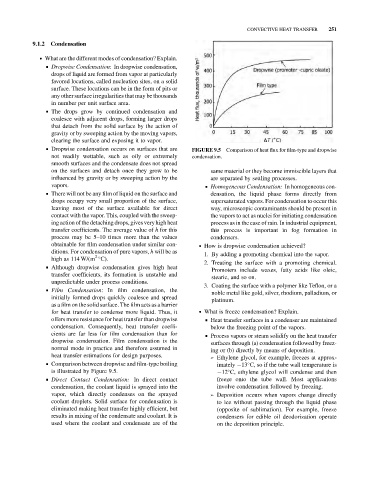
                & Dropwise condensation occurs on surfaces that are         Comparison of heat flux for film-type and dropwise
                                                                FIGURE 9.5
                  not readily wettable, such as oily or extremely  condensation.
                  smooth surfaces and the condensate does not spread
                  on the surfaces and detach once they grow to be      same material or they become immiscible layers that
                  influenced by gravity or by sweeping action by the    are separated by settling processes.
                  vapors.                                            & Homogeneous Condensation: In homogeneous con-
                & There will not be any film of liquid on the surface and  densation, the liquid phase forms directly from
                  drops occupy very small proportion of the surface,   supersaturated vapors. For condensation to occur this
                  leaving most of the surface available for direct     way, microscopic contaminants should be present in
                  contact with the vapor. This, coupled with the sweep-  the vapors to act as nuclei for initiating condensation
                  ing action of the detaching drops, givesveryhigh heat  process as in the case of rain. In industrial equipment,
                  transfer coefficients. The average value of h for this  this process is important in fog formation in
                  process may be 5–10 times more than the values       condensers.
                  obtainable for film condensation under similar con-  . How is dropwise condensation achieved?
                  ditions. For condensation of pure vapors, h will be as
                                                                    1. By adding a promoting chemical into the vapor.
                  high as 114 W/(m C).
                                2
                                                                    2. Treating the surface with a promoting chemical.
                & Although dropwise condensation gives high heat
                                                                       Promoters include waxes, fatty acids like oleic,
                  transfer coefficients, its formation is unstable and
                                                                       stearic, and so on.
                  unpredictable under process conditions.
                                                                    3. Coating the surface with a polymer like Teflon, or a
                & Film Condensation: In film condensation, the
                                                                       noble metal like gold, silver, rhodium, palladium, or
                  initially formed drops quickly coalesce and spread
                                                                       platinum.
                  as a film on the solid surface. The film acts as a barrier
                  for heat transfer to condense more liquid. Thus, it  . What is freeze condensation? Explain.
                  offers more resistance for heat transfer than dropwise  & Heat transfer surfaces in a condenser are maintained
                  condensation. Consequently, heat transfer coeffi-     below the freezing point of the vapors.
                  cients are far less for film condensation than for  & Process vapors or steam solidify on the heat transfer
                  dropwise condensation. Film condensation is the      surfaces through (a) condensation followed by freez-
                  normal mode in practice and therefore assumed in     ing or (b) directly by means of deposition.
                  heat transfer estimations for design purposes.       ➢ Ethylene glycol, for example, freezes at approx-
                & Comparison between dropwise and film-type boiling       imately  13 C, so if the tube wall temperature is

                  is illustrated by Figure 9.5.                           12 C, ethylene glycol will condense and then

                & Direct Contact Condensation: In direct contact         freeze onto the tube wall. Most applications
                  condensation, the coolant liquid is sprayed into the   involve condensation followed by freezing.
                  vapor, which directly condenses on the sprayed       ➢ Deposition occurs when vapors change directly
                  coolant droplets. Solid surface for condensation is    to ice without passing through the liquid phase
                  eliminated making heat transfer highly efficient, but   (opposite of sublimation). For example, freeze
                  results in mixing of the condensate and coolant. It is  condensers for edible oil deodorization operate
                  used where the coolant and condensate are of the       on the deposition principle.

