


Page 271 - Fluid mechanics, heat transfer, and mass transfer
P. 271
CONVECTIVE HEAT TRANSFER BASICS
252
. Give an application of freeze condensation and state its tube and drips off on to the next tube below it. The
advantages. flow is almost always laminar as the flow path is too
short for turbulence to develop, especially so for
& Removal of process vapors by either freeze conden-
viscous fluids. For low-viscosity fluids, turbulent
sation or condensation ahead of a vacuum system
flow is possible.
such as an ejector. Results in a more efficient overall
vacuum system. & If the vapor flow rate is high, vapor shear action in
cross-flow on the condensate film becomes signifi-
& Substantially lower consumption of high-pressure
cant in blowing off the condensate, carrying it down-
motive steam (e.g., 500 kg/h (1100 lb/h) compared
stream as a spray. This shear effect makes the film
to 4536 kg/h (10,000 lb/h) for conventional ejector
turbulent even earlier than it would have under the
system).
influence of gravity alone.
& Lower cooling water requirements, for example,
3
3
28 m /h(125 gpm)comparedto455 m /h(2000 gpm). & Heat transfer coefficients for dropwise condensation
may be as much as 10 times as high as the rates for
& Much smaller and easier to maintain ejector system
film condensation.
(largest ejector is 3–4 m long compared to 12 m long
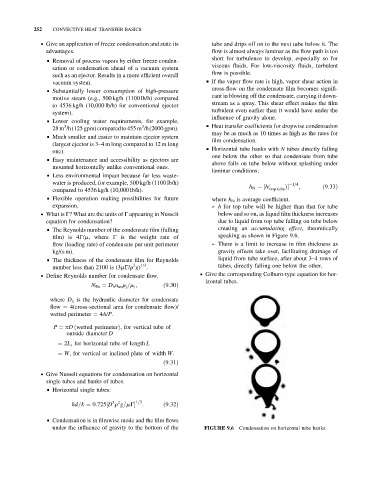
& Horizontal tube banks with N tubes directly falling
one).
one below the other so that condensate from tube
& Easy maintenance and accessibility as ejectors are
above falls on tube below without splashing under
mounted horizontally unlike conventional ones.
laminar conditions:
& Less environmental impact because far less waste-
water is produced, for example, 500 kg/h (1100 lb/h) 1=4
h N ¼½hð top tube Þ ; ð9:33Þ
compared to 4536 kg/h (10,000 lb/h).
& Flexible operation making possibilities for future where h N is average coefficient.
expansion. ➢ h for top tube will be higher than that for tube
. What is G? What are the units of G appearing in Nusselt below and so on, as liquid film thickness increases
equation for condensation? due to liquid from top tube falling on tube below
& The Reynolds number of the condensate film (falling creating an accumulating effect, theoretically
film) is 4G/m, where G is the weight rate of speaking as shown in Figure 9.6.
flow (loading rate) of condensate per unit perimeter ➢ There is a limit to increase in film thickness as
kg/(s m). gravity effects take over, facilitating drainage of
& The thickness of the condensate film for Reynolds liquid from tube surface, after about 3–4 rows of
2
1/3
number less than 2100 is (3mG/r g) . tubes, directly falling one below the other.
. Define Reynolds number for condensate flow. . Give the corresponding Colburn-type equation for hor-
izontal tubes.
N Re ¼ D h u av r =m ; ð9:30Þ
l
l
where D h is the hydraulic diameter for condensate
flow ¼ 4(cross-sectional area for condensate flow)/
wetted perimeter ¼ 4A/P.
P ¼ pD ðwetted perimeterÞ; for vertical tube of
outside diameter D
¼ 2L; for horizontal tube of length L
¼ W; for vertical or inclined plate of width W:
ð9:31Þ
. Give Nusselt equations for condensation on horizontal
single tubes and banks of tubes.
& Horizontal single tubes:
3 2 1=3
hd=k ¼ 0:725½D r g=mG : ð9:32Þ
& Condensation is in filmwise mode and the film flows
under the influence of gravity to the bottom of the FIGURE 9.6 Condensation on horizontal tube banks.

