


Page 274 - Fluid mechanics, heat transfer, and mass transfer
P. 274
CONVECTIVE HEAT TRANSFER   255

                & The entrances to the many nucleation sites are       (2–6 C for water). Liquid is slightly superheated and

                  restricted in order to retain part of the vapor in   vaporizes when it reaches the surface.
                  the form of a bubble and to prevent flooding of the  & Nucleate Boiling (B C): When the surface tempera-
                                                                                       0
                  site when liquid replaces the escaping bubble.       ture is increased beyond the boiling point, small
                & Many individual sites are also interconnected so that  vapor bubbles form at points along the heater surface.
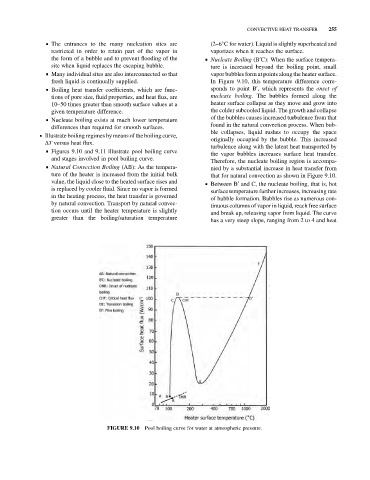
                  fresh liquid is continually supplied.                In Figure 9.10, this temperature difference corre-
                                                                                      0
                & Boiling heat transfer coefficients, which are func-   sponds to point B , which represents the onset of
                  tions of pore size, fluid properties, and heat flux, are  nucleate boiling. The bubbles formed along the
                  10–50 times greater than smooth surface values at a  heater surface collapse as they move and grow into
                  given temperature difference.                        the colder subcooled liquid. The growth and collapse
                                                                       of the bubbles causes increased turbulence from that
                & Nucleate boiling exists at much lower temperature
                                                                       found in the natural convection process. When bub-
                  differences than required for smooth surfaces.
                                                                       ble collapses, liquid rushes to occupy the space
              . Illustrate boiling regimes by means of the boiling curve,
                                                                       originally occupied by the bubble. This increased
                DT versus heat flux.
                                                                       turbulence along with the latent heat transported by
                & Figures 9.10 and 9.11 illustrate pool boiling curve
                                                                       the vapor bubbles increases surface heat transfer.
                  and stages involved in pool boiling curve.
                                                                       Therefore, the nucleate boiling region is accompa-
                & Natural Convection Boiling (AB): As the tempera-
                                                                       nied by a substantial increase in heat transfer from
                  ture of the heater is increased from the initial bulk  that for natural convection as shown in Figure 9.10.
                  value, the liquid close to the heated surface rises and  & Between B and C, the nucleate boiling, that is, hot
                                                                                0
                  is replaced by cooler fluid. Since no vapor is formed
                                                                       surface temperature further increases, increasing rate
                  in the heating process, the heat transfer is governed
                                                                       of bubble formation. Bubbles rise as numerous con-
                  by natural convection. Transport by natural convec-
                                                                       tinuous columns of vapor in liquid, reach free surface
                  tion occurs until the heater temperature is slightly
                                                                       and break up, releasing vapor from liquid. The curve
                  greater than the boiling/saturation temperature      has a very steep slope, ranging from 2 to 4 and heat


                                                 Pool boiling curve for water at atmospheric pressure.
                                    FIGURE 9.10

