


Page 269 - Fluid mechanics, heat transfer, and mass transfer
P. 269
CONVECTIVE HEAT TRANSFER BASICS
250
where DT ¼ T w T b and b is the coefficient of volu- & For a pipe, surface roughness is higher and hence
metric expansion. fluid flowing near the wall gets disturbed by the local
& Applicable for tube wall temperatures that are too surface projections, that is, roughness. This increases
low to initiate nucleate boiling. local turbulence, thereby increasing heat transfer
coefficients. It should be noted that pressure drop
. Is the following correlation for forced or for natural
convention? How do you know? also increases.
. What is the effect of vibrations and pulsations on heat
1=4 transfer coefficients?
N Nu ¼ 0:2 ½ðN Gr N Pr Þ =ðL=dÞ: ð9:27Þ
& Vibrations/pulsations increase turbulence that results
& The above equation is for natural convection. N Gr ,
in increased heat transfer coefficients.
Grashof number involves buoyancy forces that are . What is the difference between film coefficients and
based on density differences. In forced convection,
overall coefficients?
buoyancy forces have limited influence.
& Film coefficient involves the resistance for heat
. If the velocity of the fluid that is flowing in laminar flow
transfer offered by the individual fluid film.It is
in a pipe is doubled, how will the heat transfer coeffi-
assumed that all the resistance offered by the fluid
cient change?
lies in a fictitious film of the fluid. It is a direct
& Heat transfer coefficient is proportional to v 0.4 for measure of heat transfer rate per unit time per unit
turbulent flow and to v 1/3 for laminar flow. In both the area per unit temperature difference.
cases, h will increase by doubling velocity.
& Overall coefficient includes all the resistances for
& If flow changes over to turbulence conditions, h will
heat transfer between two fluids separated by a solid
be higher than change over, falling within the range barrier that includes the metal wall and the solid
of laminar conditions. deposits on both sides of the metal wall in a heat
. Give an equation for the estimation of heat transfer exchanger. In other words, overall coefficient gives a
coefficients to banks of tubes. measure of the combined heat transfer rate through a
n 1=3 series of barriers consisting of two fluid films, metal
hD=k ¼ CðDV max r=mÞ N : ð9:28Þ
Pr
wall, and two solid deposits on both sides of the metal
wall.
& Values of the constants C and n depend on whether
. Under what circumstances overall heat transfer coeffi-
tube banks are arranged in-line or staggered.
cient can be approximated to an individual film
& In-line: 0.05 < C < 0.5 and 0.55 < n < 0.8.
coefficient?
& Staggered: 0.2 < C < 0.6 and 0.55 < n < 0.65.
& When one of the film coefficients is very large
& V max ¼ maximum fluid velocity and m ¼ viscosity.
compared to the other and resistances offered by the
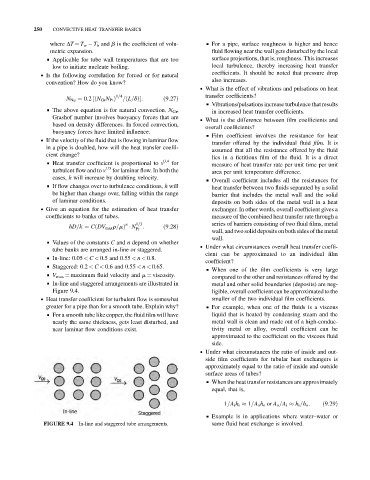
& In-line and staggered arrangements are illustrated in metal and other solid boundaries (deposits) are neg-
Figure 9.4. ligible, overall coefficient can be approximated to the
. Heat transfer coefficient for turbulent flow is somewhat smaller of the two individual film coefficients.
greater for a pipe than for a smooth tube. Explain why? & For example, when one of the fluids is a viscous
& For a smooth tube like copper, the fluid film will have liquid that is heated by condensing steam and the
nearly the same thickness, gets least disturbed, and metal wall is clean and made out of a high-conduc-
near laminar flow conditions exist. tivity metal or alloy, overall coefficient can be
approximated to the coefficient on the viscous fluid
side.
. Under what circumstances the ratio of inside and out-
side film coefficients for tubular heat exchangers is
approximately equal to the ratio of inside and outside
surface areas of tubes?
& When the heat transfer resistances are approximately
equal, that is,
1=A i h i 1=A o h o or A o =A i h i =h o : ð9:29Þ
& Example is in applications where water–water or
FIGURE 9.4 In-line and staggered tube arrangements. same fluid heat exchange is involved.

