


Page 272 - Fluid mechanics, heat transfer, and mass transfer
P. 272
CONVECTIVE HEAT TRANSFER 253
ðh=C p GÞðN Pr Þ¼ 4:4=ð4G=mÞ; ð9:34Þ
1/3
2
where G ¼ G/(3mG/r g) .
. Write Nusselt and corresponding Colburn-type equa-
tions for condensation on vertical tubes.
& Nusselt:
3 2 1=4
hL=k ¼ 0:943½L r gl=km DT : ð9:35Þ
& Colburn Type:
ðh=C p GÞðN Pr Þ¼ 5:35=ð4G=mÞ: ð9:36Þ
. Explain the applicability of the above equation.
& The equation for vertical tubes is derived on the
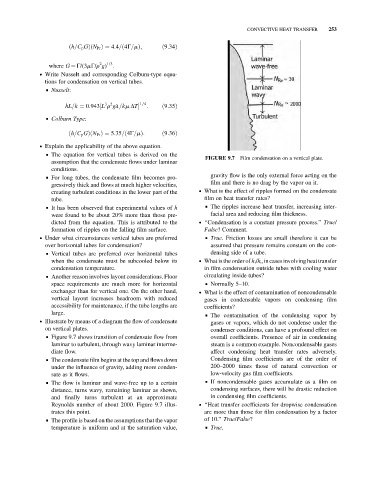
Film condensation on a vertical plate.
assumption that the condensate flows under laminar FIGURE 9.7
conditions.
gravity flow is the only external force acting on the
& For long tubes, the condensate film becomes pro-
film and there is no drag by the vapor on it.
gressively thick and flows at much higher velocities,
creating turbulent conditions in the lower part of the . What is the effect of ripples formed on the condensate
tube. film on heat transfer rates?
& It has been observed that experimental values of h & The ripples increase heat transfer, increasing inter-
were found to be about 20% more than those pre- facial area and reducing film thickness.
dicted from the equation. This is attributed to the . ‘‘Condensation is a constant pressure process.’’ True/
formation of ripples on the falling film surface. False? Comment.
. Under what circumstances vertical tubes are preferred & True. Friction losses are small therefore it can be
over horizontal tubes for condensation? assumed that pressure remains constant on the con-
& Vertical tubes are preferred over horizontal tubes densing side of a tube.
when the condensate must be subcooled below its . What is the order of h i /h o in cases involving heat transfer
condensation temperature. in film condensation outside tubes with cooling water
& Another reason involves layout considerations. Floor circulating inside tubes?
space requirements are much more for horizontal & Normally 5–10.
exchanger than for vertical one. On the other hand, . What is the effect of contamination of noncondensable
vertical layout increases headroom with reduced gases in condensable vapors on condensing film
accessibility for maintenance, if the tube lengths are coefficients?
large.
& The contamination of the condensing vapor by
. Illustrate by means of a diagram the flow of condensate gases or vapors, which do not condense under the
on vertical plates. condenser conditions, can have a profound effect on
& Figure 9.7 shows transition of condensate flow from overall coefficients. Presence of air in condensing
laminar to turbulent, through wavy laminar interme- steam is a common example. Noncondensable gases
diate flow. affect condensing heat transfer rates adversely.
& The condensate film begins at the top and flows down Condensing film coefficients are of the order of
under the influence of gravity, adding more conden- 200–2000 times those of natural convection or
sate as it flows. low-velocity gas film coefficients.
& The flow is laminar and wave-free up to a certain & If noncondensable gases accumulate as a film on
distance, turns wavy, remaining laminar as shown, condensing surfaces, there will be drastic reduction
and finally turns turbulent at an approximate in condensing film coefficients.
Reynolds number of about 2000. Figure 9.7 illus- . ‘‘Heat transfer coefficients for dropwise condensation
trates this point. are more than those for film condensation by a factor
& The profile is based on the assumptions that the vapor of 10.’’ True/False?
temperature is uniform and at the saturation value, & True.

