


Page 275 - Fluid mechanics, heat transfer, and mass transfer
P. 275
CONVECTIVE HEAT TRANSFER BASICS
            256
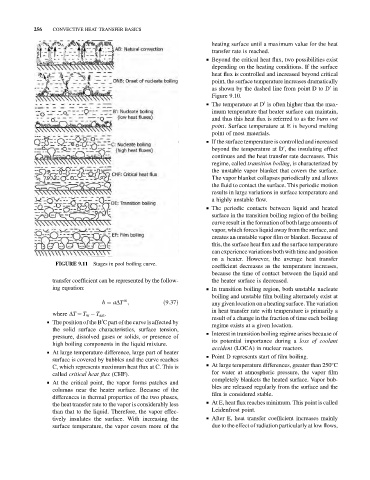
                                                                       heating surface until a maximum value for the heat
                                                                       transfer rate is reached.
                                                                     & Beyond the critical heat flux, two possibilities exist
                                                                       depending on the heating conditions. If the surface
                                                                       heat flux is controlled and increased beyond critical
                                                                       point, the surface temperature increases dramatically
                                                                       as shown by the dashed line from point D to D in
                                                                                                              0
                                                                       Figure 9.10.
                                                                                        0
                                                                     & The temperature at D is often higher than the max-
                                                                       imum temperature that heater surface can maintain,
                                                                       and thus this heat flux is referred to as the burn out
                                                                       point. Surface temperature at E is beyond melting
                                                                       point of most materials.
                                                                     & If the surface temperature is controlled and increased
                                                                                               0
                                                                       beyond the temperature at D , the insulating effect
                                                                       continues and the heat transfer rate decreases. This
                                                                       regime, called transition boiling, is characterized by
                                                                       the unstable vapor blanket that covers the surface.
                                                                       The vapor blanket collapses periodically and allows
                                                                       the fluid to contact the surface. This periodic motion
                                                                       results in large variations in surface temperature and
                                                                       a highly unstable flow.
                                                                     & The periodic contacts between liquid and heated
                                                                       surface in the transition boiling region of the boiling
                                                                       curve result in the formation of both large amounts of
                                                                       vapor, which forces liquid away from the surface, and
                                                                       creates an unstable vapor film or blanket. Because of
                                                                       this, the surface heat flux and the surface temperature
                                                                       can experience variations both with time and position
                                                                       on a heater. However, the average heat transfer
                                Stages in pool boiling curve.
                                                                       coefficient decreases as the temperature increases,
                   FIGURE 9.11
                                                                       because the time of contact between the liquid and
                  transfer coefficient can be represented by the follow-  the heater surface is decreased.
                  ing equation:                                      & In transition boiling region, both unstable nucleate
                                                                       boiling and unstable film boiling alternately exist at
                                          m
                                   h ¼ aDT ;           ð9:37Þ          any given location on a heating surface. The variation
                                                                       in heat transfer rate with temperature is primarily a
                  where DT ¼ T w   T sat .
                                                                       result of a change in the fraction of time each boiling
                                   0
                 & The position of the B C part of the curve is affected by
                                                                       regime exists at a given location.
                  the solid surface characteristics, surface tension,
                                                                     & Interest in transition boiling regime arises because of
                  pressure, dissolved gases or solids, or presence of
                                                                       its potential importance during a loss of coolant
                  high boiling components in the liquid mixture.
                                                                       accident (LOCA) in nuclear reactors.
                 & At large temperature difference, large part of heater
                                                                     & Point D represents start of film boiling.
                  surface is covered by bubbles and the curve reaches
                                                                     & At large temperature differences, greater than 250 C

                  C, which represents maximum heat flux at C. This is
                  called critical heat flux (CHF).                      for water at atmospheric pressure, the vapor film
                                                                       completely blankets the heated surface. Vapor bub-
                 & At the critical point, the vapor forms patches and
                                                                       bles are released regularly from the surface and the
                  columns near the heater surface. Because of the
                                                                       film is considered stable.
                  differences in thermal properties of the two phases,
                  the heat transfer rate to the vapor is considerably less  & At E, heat flux reaches minimum. This point is called
                  than that to the liquid. Therefore, the vapor effec-  Leidenfrost point.
                  tively insulates the surface. With increasing the  & After E, heat transfer coefficient increases mainly
                  surface temperature, the vapor covers more of the    due to the effect of radiation particularly at low flows,

