


Page 278 - Fluid mechanics, heat transfer, and mass transfer
P. 278
CONVECTIVE HEAT TRANSFER   259

              . What is slug flow film boiling?
                & Slug flow film boiling is usually encountered at low
                  flows and void fractions that are too high to maintain
                  inverted annular film boiling but too low to maintain
                  dispersed flow film boiling.
              . What is dispersed flow film boiling?
                & The dispersed flow film boiling regime is character-
                  ized by the existence of discrete liquid drops
                  entrained in a continuous vapor flow.
                & This flow regime may be defined as dispersed flow
                  film boiling, liquid-deficient heat transfer, or mist
                  flow.
                & It is of importance in nuclear reactor cores for off-
                  normal conditions as well as in steam generators.
                & The dispersed flow film boiling regime usually
                  occurs at void fractions in excess of 40%.
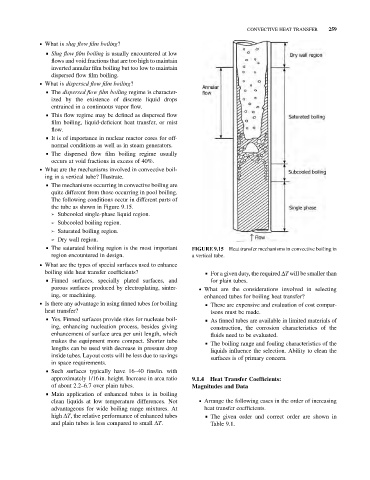
              . What are the mechanisms involved in convective boil-
                ing in a vertical tube? Illustrate.
                & The mechanisms occurring in convective boiling are
                  quite different from those occurring in pool boiling.
                  The following conditions occur in different parts of
                  the tube as shown in Figure 9.15.
                  ➢ Subcooled single-phase liquid region.
                  ➢ Subcooled boiling region.
                  ➢ Saturated boiling region.
                  ➢ Dry wall region.
                & The saturated boiling region is the most important
                                                                FIGURE 9.15  Heat transfer mechanisms in convective boiling in
                  region encountered in design.                 a vertical tube.
              . What are the types of special surfaces used to enhance
                boiling side heat transfer coefficients?              & For a given duty, the required DT will be smaller than
                & Finned surfaces, specially plated surfaces, and      for plain tubes.
                  porous surfaces produced by electroplating, sinter-  . What are the considerations involved in selecting
                  ing, or machining.                                enhanced tubes for boiling heat transfer?
              . Is there any advantage in using finned tubes for boiling  & These are expensive and evaluation of cost compar-
                heat transfer?                                         isons must be made.
                & Yes. Finned surfaces provide sites for nucleate boil-  & As finned tubes are available in limited materials of
                  ing, enhancing nucleation process, besides giving    construction, the corrosion characteristics of the
                  enhancement of surface area per unit length, which   fluids need to be evaluated.
                  makes the equipment more compact. Shorter tube     & The boiling range and fouling characteristics of the
                  lengths can be used with decrease in pressure drop
                                                                       liquids influence the selection. Ability to clean the
                  inside tubes. Layout costs will be less due to savings
                                                                       surfaces is of primary concern.
                  in space requirements.
                & Such surfaces typically have 16–40 fins/in. with
                  approximately 1/16 in. height. Increase in area ratio
                                                                9.1.4  Heat Transfer Coefficients:
                  of about 2.2–6.7 over plain tubes.
                                                                Magnitudes and Data
                & Main application of enhanced tubes is in boiling
                  clean liquids at low temperature differences. Not  . Arrange the following cases in the order of increasing
                  advantageous for wide boiling range mixtures. At  heat transfer coefficients.
                  high DT, the relative performance of enhanced tubes  & The given order and correct order are shown in
                  and plain tubes is less compared to small DT.        Table 9.1.

