


Page 281 - Fluid mechanics, heat transfer, and mass transfer
P. 281
CONVECTIVE HEAT TRANSFER BASICS
            262
                                                                       ➢ Low thermal diffusivity.
            TABLE 9.4  Recommended U for Broad Categories of
                                                                       ➢ Low freezing point (at least 20 C lower than the
            Design Applications
            Category                                W/(m C)              lowest operating temperature) to avoid freezing on
                                                         2
                                                                         the heat transfer surfaces.
            Water–liquid                              850
            Liquid–liquid                             280              ➢ High flash point and high self-ignition tempera-
            Liquid–gas                                60                 tures making it less susceptible to ignition.
            Gas–gas                                   30               ➢ From ignition point of view, not only flash point
            Reboilers                                 1140               and self-ignition temperature but also tendency for
                                                                         formation of aerosols during use of heat transfer
                                                                         fluids is an important criterion. The following four
                 & Annexure gives typical ranges of heat transfer
                                                                         properties/conditions of the heat transfer fluids
                  coefficients that can be used in the preliminary        influence this tendency:
                  design of heat transfer equipment in different         - Higher density fluids tend to form smaller dro-
                  refinery units.                                           plets upon leaking.
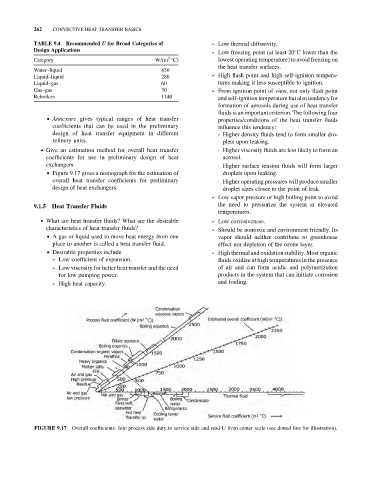
               . Give an estimation method for overall heat transfer     - Higher viscosity fluids are less likely to form an
                coefficients for use in preliminary design of heat          aerosol.
                exchangers.                                              - Higher surface tension fluids will form larger
                 & Figure 9.17 gives a nomograph for the estimation of     droplets upon leaking.
                  overall heat transfer coefficients for preliminary      - Higher operating pressures will produce smaller
                  design of heat exchangers.                               droplet sizes closer to the point of leak.
                                                                       ➢ Low vapor pressure or high boiling point to avoid
                                                                         the need to pressurize the system at elevated
            9.1.5  Heat Transfer Fluids
                                                                         temperatures.
               . What are heat transfer fluids? What are the desirable  ➢ Low corrosiveness.
                characteristics of heat transfer fluids?                ➢ Should be nontoxic and environment friendly. Its
                 & A gas or liquid used to move heat energy from one     vapor should neither contribute to greenhouse
                  place to another is called a heat transfer fluid.       effect nor depletion of the ozone layer.
                 & Desirable properties include                        ➢ High thermal and oxidation stability. Most organic
                  ➢ Low coefficient of expansion.                         fluids oxidize at high temperatures in the presence
                  ➢ Low viscosity for better heat transfer and the need  of air and can form acidic and polymerization
                    for low pumping power.                               products in the system that can initiate corrosion
                  ➢ High heat capacity.                                  and fouling.


                         Overall coefficients. Join process side duty to service side and read U from center scale (see dotted line for illustration).
            FIGURE 9.17

