


Page 286 - Fluid mechanics, heat transfer, and mass transfer
P. 286
CONVECTIVE HEAT TRANSFER   267


                  are all flammable from 180 to 540 C. Most of these  . Why is it necessary to deaerate water used for steam
                  fluids have toxic effects and irritate eyes and skin.  generation?
              . Summarize fluids used as heat transfer media and their  & Dissolved air in water gets released on vaporization
                working temperature ranges.                            of water for steam generation. Thus, steam will be
                                                                       contaminated by air, which is a noncondensable gas.
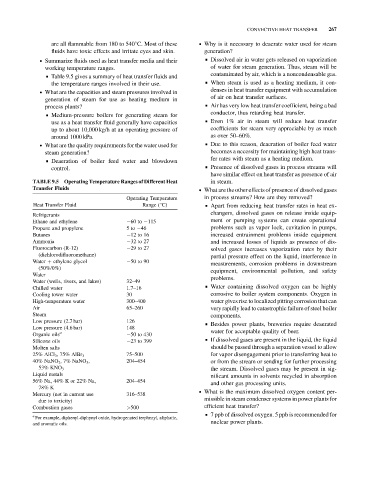
                & Table 9.5 gives a summary of heat transfer fluids and
                  the temperature ranges involved in their use.      & When steam is used as a heating medium, it con-
                                                                       denses in heat transfer equipment with accumulation
              . What are the capacities and steam pressures involved in
                                                                       of air on heat transfer surfaces.
                generation of steam for use as heating medium in
                process plants?                                      & Air has very low heat transfer coefficient, being a bad
                                                                       conductor, thus retarding heat transfer.
                & Medium-pressure boilers for generating steam for
                  use as a heat transfer fluid generally have capacities  & Even 1% air in steam will reduce heat transfer
                  up to about 10,000 kg/h at an operating pressure of  coefficients for steam very appreciable by as much
                  around 1000 kPa.                                     as over 50–60%.
              . What are the quality requirements for the water used for  & Due to this reason, deaeration of boiler feed water
                steam generation?                                      becomes a necessity for maintaining high heat trans-
                                                                       fer rates with steam as a heating medium.
                & Deaeration of boiler feed water and blowdown
                  control.                                           & Presence of dissolved gases in process streams will
                                                                       have similar effect on heat transfer as presence of air
                                                                       in steam.
            TABLE 9.5  Operating Temperature Ranges of Different Heat
            Transfer Fluids                                        . What are the other effects of presence of dissolved gases
                                           Operating Temperature    in process streams? How are they removed?
            Heat Transfer Fluid                 Range ( C)           & Apart from reducing heat transfer rates in heat ex-

            Refrigerants                                               changers, dissolved gases on release inside equip-
            Ethane and ethylene             60 to  115                 ment or pumping systems can create operational
            Propane and propylene          5 to  46                    problems such as vapor lock, cavitation in pumps,
            Butanes                         12 to 16                   increased entrainment problems inside equipment
            Ammonia                         32 to 27                   and increased losses of liquids as presence of dis-
            Fluorocarbon (R-12)             29 to 27                   solved gases increases vaporization rates by their
              (dichlorodifluoromethane)                                 partial pressure effect on the liquid, interference in
            Water þ ethylene glycol         50 to 90
                                                                       measurements, corrosion problems in downstream
              (50%/0%)
                                                                       equipment, environmental pollution, and safety
            Water
                                                                       problems.
            Water (wells, rivers, and lakes)  32–49
                                                                     & Water containing dissolved oxygen can be highly
            Chilled water                  1.7–16
            Cooling tower water            30                          corrosive to boiler system components. Oxygen in
            High-temperature water         300–400                     water gives rise to localized pitting corrosion that can
            Air                            65–260                      very rapidly lead to catastrophic failure of steel boiler
            Steam                                                      components.
            Low pressure (2.7 bar)         126
                                                                     & Besides power plants, breweries require deaerated
            Low pressure (4.6 bar)         148
            Organic oils a                  50 to 430                  water for acceptable quality of beer.
                                                                     & If dissolved gases are present in the liquid, the liquid
            Silicone oils                   23 to 399
            Molten salts                                               should be passed through a separation vessel to allow
                                           75–500                      for vapor disengagement prior to transferring heat to
            25% AlCl 3 , 75% AlBr 3
            40% NaNO 2 , 7% NaNO 3 ,       204–454                     or from the stream or sending for further processing
                                                                       the stream. Dissolved gases may be present in sig-
              53% KNO 3
            Liquid metals
                                                                       nificant amounts in solvents recycled in absorption
            56% Na, 44% K or 22% Na,       204–454
                                                                       and other gas processing units.
              78% K
                                                                   . What is the maximum dissolved oxygen content per-
            Mercury (not in current use    316–538
              due to toxicity)                                      missible in steam condenser systems in power plants for
            Combustion gases               >500                     efficient heat transfer?
                                                                     & 7 ppb of dissolved oxygen. 5 ppb is recommended for
            a
             For example, diphenyl-diphynyl oxide, hydrogenated terphenyl, aliphatic,
            and aromatic oils.                                         nuclear power plants.

