


Page 288 - Fluid mechanics, heat transfer, and mass transfer
P. 288
ANNEXURE (HEAT TRANSFER COEFFICIENTS FOR REFINERY SERVICES)  269

                & The required blowdown rate is estimated by the  TABLE 9.6  (Continued )
                  following formula:
                                                                                                           2
                                                                                                 Range (W/(m C))
                                                                                                          2
                                                                 Refinery Unit                       (Btu/(h ft F))
                       Blowdown rate ¼ F   S=ðB FÞ;    ð9:46Þ
                                                                Thermal cracking
                  where F is the TDS in feed water (mg/L), S is the
                                                                Coker combination TWR condenser  227 (40)–284 (50)
                  steam generation rate (kg/h), and B is the maximum  Gas oil/gas oil           170 (30)–227 (40)
                  TDS in the boiler (mg/L).                     Gas oil cracker overhead condenser  255 (45)–369 (65)
                                                                Gas oil reflux steam generation  454 (80)–511 (90)
                                                                Gasoline/naphtha charge         341 (60)–454 (80)
                                                                Thermal tar cooler (box)        57 (10)–114 (20)
            9.2  ANNEXURE (HEAT TRANSFER
                                                                Thermal tar steam generation    227 (40)–284 (50)
            COEFFICIENTS FOR REFINERY SERVICES)
                                                                Top reflux/BFW                   341 (60)–454 (80)
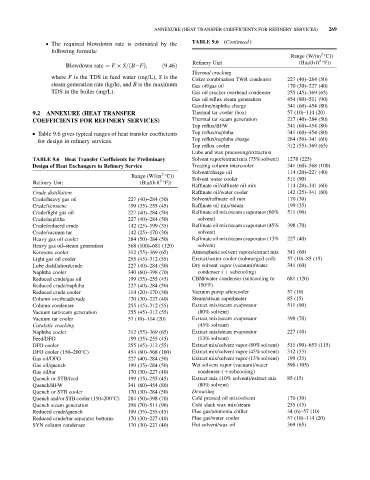
            & Table 9.6 gives typical ranges of heat transfer coefficients  Top reflux/naphtha    341 (60)–454 (80)
              for design in refinery services.                   Top reflux/naphtha charge        284 (50)–341 (60)
                                                                Top reflux cooler                312 (55)–369 (65)
                                                                Lube and wax processing/extraction
                                                                Solvent vapor/extract mix (75% solvent)  1278 (225)
            TABLE 9.6  Heat Transfer Coefficients for Preliminary
                                                                Treating column intercooler     341 (60)–568 (100)
            Design of Heat Exchangers in Refinery Service
                                                                Solvent/charge oil              114 (20)–227 (40)
                                            Range (W/(m C))
                                                      2
                                                                Solvent water cooler            511 (90)
                                                      2
            Refinery Unit                       (Btu/(h ft F))
                                                                Raffinate oil/raffinate oil mix   114 (20)–341 (60)
            Crude distillation                                  Raffinate oil/water cooler       142 (25)–341 (60)
            Crude/heavy gas oil            227 (40)–284 (50)    Solvent/raffinate oil mix        170 (30)
            Crude/kerosene                 199 (35)–255 (45)    Raffinate oil mix/steam          199 (35)
            Crude/light gas oil            227 (40)–284 (50)    Raffinate oil mix/steam evaporator (80%  511 (90)
            Crude/naphtha                  227 (40)–284 (50)      solvent)
            Crude/reduced crude            142 (25)–199 (35)    Raffinate oil mix/steam evaporator (45%  398 (70)
            Crude/vacuum tar               142 (25)–170 (30)      solvent)
            Heavy gas oil cooler           284 (50)–284 (50)    Raffinate oil mix/steam evaporator (13%  227 (40)
            Heavy gas oil–steam generation  568 (100)–681 (120)   solvent)
            Kerosene cooler                312 (55)–369 (65)    Atmospheric solvent vapors/extract mix  341 (60)
            Light gas oil cooler           255 (45)–312 (55)    Extract/water cooler (submerged coil)  57 (10)–85 (15)
            Lube distillation/crude        227 (40)–284 (50)    Dry solvent vapor (vacuum)/water  341 (60)
            Naphtha cooler                 340 (60)–398 (70)      condenser ( þ subcooling)
            Reduced crude/gas oil          199 (35)–255 (45)    CBM/water condenser (subcooling to  681 (120)

            Reduced crude/naphtha          227 (40)–284 (50)      150 F)
            Reduced crude cooler           114 (20)–170 (30)    Vacuum pump aftercooler         57 (10)
            Column overhead/crude          170 (30)–227 (40)    Steam/steam superheater         85 (15)
            Column condenser               255 (45)–312 (55)    Extract mix/steam evaporator    511 (90)
            Vacuum tar/steam generation    255 (45)–312 (55)      (80% solvent)
            Vacuum tar cooler              57 (10)–114 (20)     Extract mix/steam evaporator    398 (70)
            Catalytic cracking                                    (45% solvent)
            Naphtha cooler                 312 (55)–369 (65)    Extract mix/steam evaporator    227 (40)
            Feed/DFO                       199 (35)–255 (45)      (13% solvent)
            DFO cooler                     255 (45)–312 (55)    Extract mix/solvent vapor (80% solvent)  511 (90)–653 (115)

            DFO cooler (150–200 C)         454 (80)–568 (100)   Extract mix/solvent vapor (45% solvent)  312 (55)
            Gas oil/DFO                    227 (40)–284 (50)    Extract mix/solvent vapor (13% solvent)  199 (35)
            Gas oil/quench                 199 (35)–284 (50)    Wet solvent vapor (vacuum)/water  596 (105)
            Gas oil/tar                    170 (30)–227 (40)      condenser ( þ subcooling)
            Quench or STB/feed             199 (35)–255 (45)    Extract mix (10% solvent)/extract mix  85 (15)
            Quench/BFW                     341 (60)–454 (80)      (80% solvent)
            Quench or STB cooler           170 (30)–284 (50)    Dewaxing
            Quench and/or STB cooler (150–200 C)  284 (50)–398 (70)  Cold pressed oil mix/solvent  170 (30)

            Quench steam generation        398 (70)–511 (90)    Cold slack wax mix/steam        255 (45)
            Reduced crude/quench           199 (35)–255 (45)    Flue gas/ammonia chiller        34 (6)–57 (10)
            Reduced crude/tar separator bottoms  170 (30)–227 (40)  Flue gas/water cooler       57 (10)–114 (20)
            SYN column condenser           170 (30)–227 (40)    Hot solvent/wax oil             369 (65)

