


Page 293 - Fluid mechanics, heat transfer, and mass transfer
P. 293
SHELL AND TUBE HEAT EXCHANGERS
            274
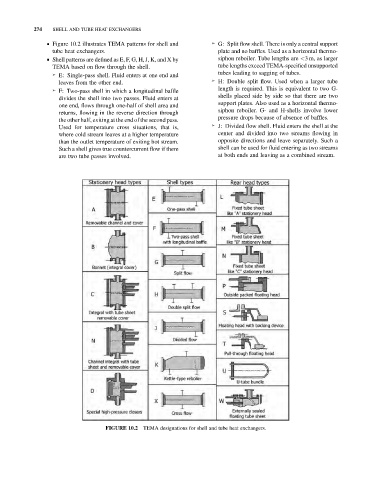
                 & Figure 10.2 illustrates TEMA patterns for shell and  ➢  G: Split flow shell. There is only a central support
                  tube heat exchangers.                                  plate and no baffles. Used as a horizontal thermo-
                 & Shell patterns are defined as E, F, G, H, J, K, and X by  siphon reboiler. Tube lengths are <3 m, as larger
                  TEMA based on flow through the shell.                   tube lengths exceed TEMA-specified unsupported
                                                                         tubes leading to sagging of tubes.
                  ➢ E: Single-pass shell. Fluid enters at one end and
                    leaves from the other end.                         ➢ H: Double split flow. Used when a larger tube
                                                                         length is required. This is equivalent to two G-
                  ➢ F: Two-pass shell in which a longitudinal baffle
                                                                         shells placed side by side so that there are two
                    divides the shell into two passes. Fluid enters at
                                                                         support plates. Also used as a horizontal thermo-
                    one end, flows through one-half of shell area and
                                                                         siphon reboiler. G- and H-shells involve lower
                    returns, flowing in the reverse direction through
                                                                         pressure drops because of absence of baffles.
                    the other half, exiting at the end of the second pass.
                    Used for temperature cross situations, that is,    ➢ J: Divided flow shell. Fluid enters the shell at the
                    where cold stream leaves at a higher temperature     center and divided into two streams flowing in
                    than the outlet temperature of exiting hot stream.   opposite directions and leave separately. Such a
                    Such a shell gives true countercurrent flow if there  shell can be used for fluid entering as two streams
                    are two tube passes involved.                        at both ends and leaving as a combined stream.


                                                TEMA designations for shell and tube heat exchangers.
                                    FIGURE 10.2

