


Page 283 - Fluid mechanics, heat transfer, and mass transfer
P. 283
CONVECTIVE HEAT TRANSFER BASICS
            264
                  heat capacity. Chlorofluorocarbon (CFC) refriger-
                  ants, such as Freon, were the primary fluids used by
                  refrigerator, air conditioner, and heat pump manu-
                  facturers because they are nonflammable, low in
                  toxicity, stable, noncorrosive, and do not freeze.
                  However, due to the negative effect of CFCs on the
                  ozone layer of the Earth, they are being phased out.
                  Ammonia can also be used as a refrigerant. It is
                  commonly used in industrial applications. These
                  can be aqueous ammonia or a calcium chloride
                  ammonia mixture.
                 & Silicones: Dimethylpolysiloxane is an example of
                  silicone oils. Its molecular weight and thermophysi-
                  cal properties can be adjusted by varying the chain
                  length. Silicones have avery low freezingpoint, and a
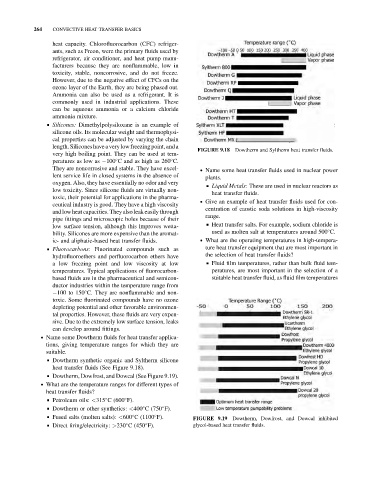
                                                                  FIGURE 9.18 Dowtherm and Syltherm heat transfer fluids.
                  very high boiling point. They can be used at tem-


                  peratures as low as  100 C and as high as 260 C.
                  They are noncorrosive and stable. They have excel-  . Name some heat transfer fluids used in nuclear power
                  lent service life in closed systems in the absence of  plants.
                  oxygen. Also, they have essentially no odor and very
                                                                     & Liquid Metals: These are used in nuclear reactors as
                  low toxicity. Since silicone fluids are virtually non-
                                                                       heat transfer fluids.
                  toxic, their potential for applications in the pharma-
                                                                   . Give an example of heat transfer fluids used for con-
                  ceutical industry is good. They have a high viscosity
                                                                     centration of caustic soda solutions in high-viscosity
                  and low heat capacities. Theyalso leak easily through
                                                                     range.
                  pipe fittings and microscopic holes because of their
                                                                     & Heat transfer salts. For example, sodium chloride is
                  low surface tension, although this improves wetta-

                  bility. Silicones are more expensive than the aromat-  used as molten salt at temperatures around 500 C.
                  ic- and aliphatic-based heat transfer fluids.     . What are the operating temperatures in high-tempera-
                 & Fluorocarbons: Fluorinated compounds such as      ture heat transfer equipment that are most important in
                  hydrofluoroethers and perfluorocarbon ethers have    the selection of heat transfer fluids?
                  a low freezing point and low viscosity at low      & Fluid film temperatures, rather than bulk fluid tem-
                  temperatures. Typical applications of fluorocarbon-   peratures, are most important in the selection of a
                  based fluids are in the pharmaceutical and semicon-   suitable heat transfer fluid, as fluid film temperatures
                  ductor industries within the temperature range from
                   100 to 150 C. They are nonflammable and non-

                  toxic. Some fluorinated compounds have no ozone
                  depleting potential and other favorable environmen-
                  tal properties. However, these fluids are very expen-
                  sive. Due to the extremely low surface tension, leaks
                  can develop around fittings.
               . Name some Dowtherm fluids for heat transfer applica-
                tions, giving temperature ranges for which they are
                suitable.
                 & Dowtherm synthetic organic and Syltherm silicone
                  heat transfer fluids (See Figure 9.18).
                 & Dowtherm, Dowfrost, and Dowcal (See Figure 9.19).
               . What are the temperature ranges for different types of
                heat transfer fluids?


                 & Petroleum oils: <315 C (600 F).
                 & Dowtherm or other synthetics: <400 C (750 F).


                 & Fused salts (molten salts): <600 C (1100 F).


                                                                 FIGURE 9.19  Dowtherm, Dowfrost, and Dowcal inhibited
                 & Direct firing/electricity: >230 C (450 F).     glycol-based heat transfer fluids.

