


Page 280 - Fluid mechanics, heat transfer, and mass transfer
P. 280
CONVECTIVE HEAT TRANSFER   261
                                    X
                  1=U ¼ 1=h o þ 1=h i þ  ðmetal wall and fouling       foreign solid material (fouling deposit) inside the
                                                                       tube, metal wall, deposits of foreign solid material
                     resistances on both sides of the metal wallÞ:
                                                                       outside the tube, and outside fluid film. Resistances
                                                       ð9:43Þ          due to deposits are significantly high due to low
                                                                       thermal conductivities of these deposit materials.
                & If the inside and outside surfaces are clean, fouling
                                                                       These resistances are lumped into what are known as
                  resistances will be zero. Generally, metal wall resis-
                                                                       fouling factors that depend on nature, thicknesses,
                  tance can be assumed to be negligible, metals being
                                                                       average thermal conductivities, structure, and
                  good conductors of heat. In such a case, the equation
                                                                       porosities of the deposits.
                  reduces to the form
                                                                     & Fouling factors contribute to decrease of heat transfer
                                                                       rates.
                               1=U ¼ 1=h o þ 1=h i :   ð9:44Þ
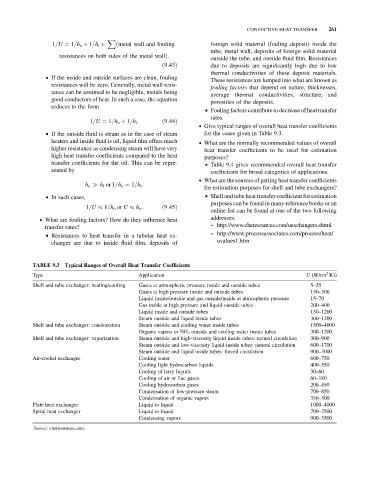
                                                                   . Give typical ranges of overall heat transfer coefficients
                & If the outside fluid is steam as in the case of steam  for the cases given in Table 9.3.
                  heaters and inside fluid is oil, liquid film offers much  . What are the normally recommended values of overall
                  higher resistance as condensing steam will have very  heat transfer coefficients to be used for estimation
                  high heat transfer coefficients compared to the heat  purposes?
                  transfer coefficients for the oil. This can be repre-  & Table 9.4 gives recommended overall heat transfer
                  sented by                                            coefficients for broad categories of applications.
                                                                   . What are the sources of getting heat transfer coefficients
                             h o   h i or 1=h o ¼ 1=h i :
                                                                    for estimation purposes for shell and tube exchangers?
                & In such cases,                                     & Shell and tube heat transfer coefficient for estimation
                                                                       purposes can be found in many reference books or an
                             1=U   1=h o or U   h o :  ð9:45Þ
                                                                       online list can be found at one of the two following
              . What are fouling factors? How do they influence heat    addresses:
                transfer rates?                                        ➢ http://www.cheresources.com/uexchangers.shtml
                & Resistances to heat transfer in a tubular heat ex-   ➢ http://www.processassociates.com/process/heat/
                  changer are due to inside fluid film, deposits of        uvalues1.htm


            TABLE 9.3  Typical Ranges of Overall Heat Transfer Coefficients
                                                                                                             2
            Type                               Application                                            U (W/(m K))
            Shell and tube exchanger: heating/cooling  Gases at atmospheric pressure inside and outside tubes  5–35
                                               Gases at high pressure inside and outside tubes          150–500
                                               Liquid inside/outside and gas outside/inside at atmospheric pressure  15–70
                                               Gas inside at high pressure and liquid outside tubes     200–400
                                               Liquid inside and outside tubes                          150–1200
                                               Steam outside and liquid inside tubes                    300–1200
            Shell and tube exchanger: condensation  Steam outside and cooling water inside tubes        1500–4000
                                               Organic vapors or NH 3 outside and cooling water inside tubes  300–1200
            Shell and tube exchanger: vaporization  Steam outside and high-viscosity liquid inside tubes: natural circulation  300–900
                                               Steam outside and low-viscosity liquid inside tubes: natural circulation  600–1700
                                               Steam outside and liquid inside tubes: forced circulation  900–3000
            Air-cooled exchanger               Cooling water                                            600–750
                                               Cooling light hydrocarbon liquids                        400–550
                                               Cooling of tarry liquids                                 30–60
                                               Cooling of air or flue gases                              60–180
                                               Cooling hydrocarbon gases                                200–450
                                               Condensation of low-pressure steam                       700–850
                                               Condensation of organic vapors                           350–500
            Plate heat exchanger               Liquid to liquid                                         1000–4000
            Spiral heat exchanger              Liquid to liquid                                         700–2500
                                               Condensing vapors                                        900–3500
            Source: cheresources.com.

