


Page 266 - Fluid mechanics, heat transfer, and mass transfer
P. 266
CONVECTIVE HEAT TRANSFER   247

                                                                       For air, these equations can be approximated respec-
                                                                       tively by
                                                                                                 0:25
                                                                                    h c ¼ 1:3ðDT=LÞ         ð9:7Þ
                                                                       and

                                                                                               0:25
                                                                                    h c ¼ 1:8ðDTÞ  :        ð9:8Þ
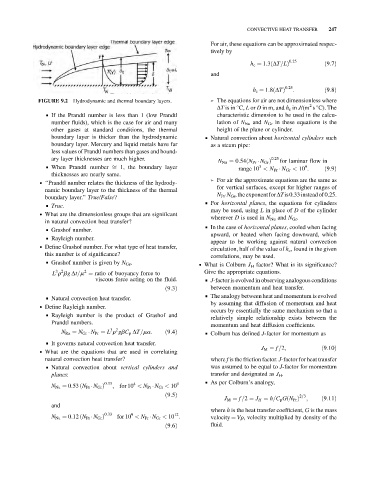
              FIGURE 9.2 Hydrodynamic and thermal boundary layers.     ➢ The equations for air are not dimensionless where
                                                                                                       2

                                                                         DT is in C, L or D in m, and h c in J/(m s C). The

                & If the Prandtl number is less than 1 (low Prandtl      characteristic dimension to be used in the calcu-
                  number fluids), which is the case for air and many      lation of N Nu and N Gr in these equations is the
                  other gases at standard conditions, the thermal        height of the plane or cylinder.
                  boundary layer is thicker than the hydrodynamic    & Natural convection about horizontal cylinders such
                  boundary layer. Mercury and liquid metals have far   as a steam pipe:
                  less values of Prandtl numbers than gases and bound-
                  ary layer thicknesses are much higher.                                   0:25
                                                                         N Nu ¼ 0:54ðN Pr   N Gr Þ  for laminar flow in
                & When Prandtl number ffi 1, the boundary layer                          3              9
                                                                                range 10 < N Pr   N Gr < 10 :  ð9:9Þ
                  thicknesses are nearly same.
                                                                       ➢ For air the approximate equations are the same as
              . ‘‘Prandtl number relates the thickness of the hydrody-
                                                                         for vertical surfaces, except for higher ranges of
                namic boundary layer to the thickness of the thermal
                                                                         N Pr  N Gr ,theexponentforDTis0.33insteadof0.25.
                boundary layer.’’ True/False?
                                                                     & For horizontal planes, the equations for cylinders
                & True.
                                                                       may be used, using L in place of D of the cylinder
              . What are the dimensionless groups that are significant
                                                                       wherever D is used in N Nu and N Gr .
                in natural convection heat transfer?
                                                                     & In the case of horizontal planes, cooled when facing
                & Grashof number.
                                                                       upward, or heated when facing downward, which
                & Rayleigh number.
                                                                       appear to be working against natural convection
              . Define Grashof number. For what type of heat transfer,
                                                                       circulation, half of the value of h c , found in the given
                this number is of significance?
                                                                       correlations, may be used.
                & Grashof number is given by N Gr ,
                                                                   . What is Colburn J H factor? What is its significance?
                   3 2
                             2
                  L r bg Dt=m ¼ ratio of buoyancy force to          Give the appropriate equations.
                                 viscous force acting on the fluid:  & J-factor is evolved in observing analogous conditions
                                                                       between momentum and heat transfer.
                                                        ð9:3Þ
                                                                     & The analogy between heat and momentum is evolved
                & Natural convection heat transfer.
                                                                       by assuming that diffusion of momentum and heat
              . Define Rayleigh number.
                                                                       occurs by essentially the same mechanism so that a
                & Rayleigh number is the product of Grashof and
                                                                       relatively simple relationship exists between the
                  Prandtl numbers.
                                                                       momentum and heat diffusion coefficients.
                                     3 2
                     N Ra ¼ N Gr   N Pr ¼ L r gbC p DT=ma:  ð9:4Þ    & Colburn has defined J-factor for momentum as
                & It governs natural convection heat transfer.
                                                                                       J M ¼ f=2;          ð9:10Þ
              . What are the equations that are used in correlating
                natural convection heat transfer?                      where f is the friction factor. J-factor for heat transfer
                & Natural convection about vertical cylinders and      was assumed to be equal to J-factor for momentum
                  planes:                                              transfer and designated as J H .
                                                                     & As per Colburn’s analogy,
                                    0:33     4             9
                  N Nu ¼ 0:53 ðN Pr  N Gr Þ  ; for 10 < N Pr  N Gr < 10
                                                        ð9:5Þ                                       2=3
                                                                           J M ¼ f=2 ¼ J H ¼ h=C p GðN Pr Þ  ;  ð9:11Þ
                  and
                                                                       where h is the heat transfer coefficient, G is the mass
                                    0:33    9              12
                  N Nu ¼ 0:12 ðN Pr  N Gr Þ  for 10 < N Pr  N Gr < 10 :  velocity ¼ Vr, velocity multiplied by density of the
                                                                       fluid.
                                                        ð9:6Þ

