


Page 554 - Forensic Structural Engineering Handbook
P. 554
15.6              MATERIAL-SPECIFIC FORENSIC ANALYSES


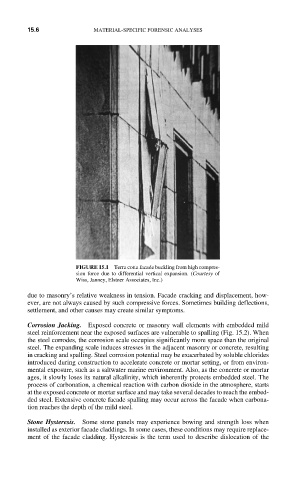
                     FIGURE 15.1  Terra cotta facade buckling from high compres-
                     sion force due to differential vertical expansion. (Courtesy of
                     Wiss, Janney, Elstner Associates, Inc.)

        due to masonry’s relative weakness in tension. Facade cracking and displacement, how-
        ever, are not always caused by such compressive forces. Sometimes building deflections,
        settlement, and other causes may create similar symptoms.

        Corrosion Jacking.  Exposed concrete or masonry wall elements with embedded mild
        steel reinforcement near the exposed surfaces are vulnerable to spalling (Fig. 15.2). When
        the steel corrodes, the corrosion scale occupies significantly more space than the original
        steel. The expanding scale induces stresses in the adjacent masonry or concrete, resulting
        in cracking and spalling. Steel corrosion potential may be exacerbated by soluble chlorides
        introduced during construction to accelerate concrete or mortar setting, or from environ-
        mental exposure, such as a saltwater marine environment. Also, as the concrete or mortar
        ages, it slowly loses its natural alkalinity, which inherently protects embedded steel. The
        process of carbonation, a chemical reaction with carbon dioxide in the atmosphere, starts
        at the exposed concrete or mortar surface and may take several decades to reach the embed-
        ded steel. Extensive concrete facade spalling may occur across the facade when carbona-
        tion reaches the depth of the mild steel.

        Stone Hysteresis.  Some stone panels may experience bowing and strength loss when
        installed as exterior facade claddings. In some cases, these conditions may require replace-
        ment of the facade cladding. Hysteresis is the term used to describe dislocation of the

