


Page 556 - Forensic Structural Engineering Handbook
P. 556
15.8              MATERIAL-SPECIFIC FORENSIC ANALYSES


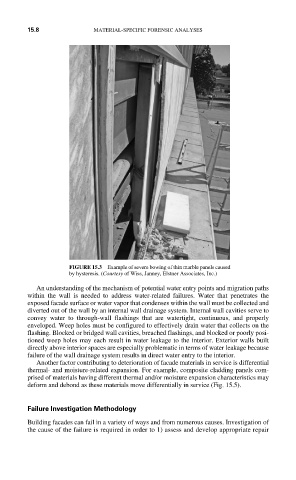
                    FIGURE 15.3  Example of severe bowing of thin marble panels caused
                    by hysteresis. (Courtesy of Wiss, Janney, Elstner Associates, Inc.)
           An understanding of the mechanism of potential water entry points and migration paths
        within the wall is needed to address water-related failures. Water that penetrates the
        exposed facade surface or water vapor that condenses within the wall must be collected and
        diverted out of the wall by an internal wall drainage system. Internal wall cavities serve to
        convey water to through-wall flashings that are watertight, continuous, and properly
        enveloped. Weep holes must be configured to effectively drain water that collects on the
        flashing. Blocked or bridged wall cavities, breached flashings, and blocked or poorly posi-
        tioned weep holes may each result in water leakage to the interior. Exterior walls built
        directly above interior spaces are especially problematic in terms of water leakage because
        failure of the wall drainage system results in direct water entry to the interior.
           Another factor contributing to deterioration of facade materials in service is differential
        thermal- and moisture-related expansion. For example, composite cladding panels com-
        prised of materials having different thermal and/or moisture expansion characteristics may
        deform and debond as these materials move differentially in service (Fig. 15.5).


        Failure Investigation Methodology
        Building facades can fail in a variety of ways and from numerous causes. Investigation of
        the cause of the failure is required in order to 1) assess and develop appropriate repair

