


Page 561 - Forensic Structural Engineering Handbook
P. 561
BUILDING FACADES                   15.13


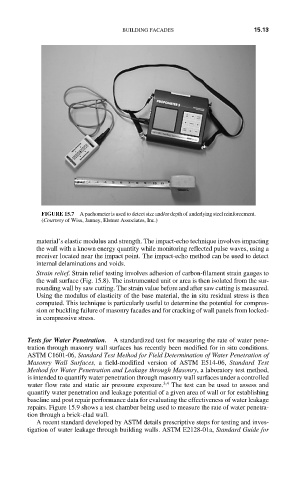
              FIGURE 15.7  A pachometer is used to detect size and/or depth of underlying steel reinforcement.
              (Courtesy of Wiss, Janney, Elstner Associates, Inc.)

             material’s elastic modulus and strength. The impact-echo technique involves impacting
             the wall with a known energy quantity while monitoring reflected pulse waves, using a
             receiver located near the impact point. The impact-echo method can be used to detect
             internal delaminations and voids.
             Strain relief. Strain relief testing involves adhesion of carbon-filament strain gauges to
             the wall surface (Fig. 15.8). The instrumented unit or area is then isolated from the sur-
             rounding wall by saw cutting. The strain value before and after saw cutting is measured.
             Using the modulus of elasticity of the base material, the in situ residual stress is then
             computed. This technique is particularly useful to determine the potential for compres-
             sion or buckling failure of masonry facades and for cracking of wall panels from locked-
             in compressive stress.


          Tests for Water Penetration.  A standardized test for measuring the rate of water pene-
          tration through masonry wall surfaces has recently been modified for in situ conditions.
          ASTM C1601-06, Standard Test Method for Field Determination of Water Penetration of
          Masonry Wall Surfaces, a field-modified version of ASTM E514-06,  Standard Test
          Method for Water Penetration and Leakage through Masonry, a laboratory test method,
          is intended to quantify water penetration through masonry wall surfaces under a controlled
          water flow rate and static air pressure exposure. 3,4  The test can be used to assess and
          quantify water penetration and leakage potential of a given area of wall or for establishing
          baseline and post repair performance data for evaluating the effectiveness of water leakage
          repairs. Figure 15.9 shows a test chamber being used to measure the rate of water penetra-
          tion through a brick-clad wall.
             A recent standard developed by ASTM details prescriptive steps for testing and inves-
          tigation of water leakage through building walls. ASTM E2128-01a, Standard Guide for

