


Page 560 - Forensic Structural Engineering Handbook
P. 560
15.12             MATERIAL-SPECIFIC FORENSIC ANALYSES


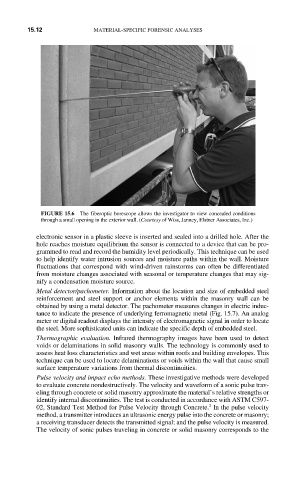
            FIGURE 15.6  The fiberoptic borescope allows the investigator to view concealed conditions
            through a small opening in the exterior wall. (Courtesy of Wiss, Janney, Elstner Associates, Inc.)

           electronic sensor in a plastic sleeve is inserted and sealed into a drilled hole. After the
           hole reaches moisture equilibrium the sensor is connected to a device that can be pro-
           grammed to read and record the humidity level periodically. This technique can be used
           to help identify water intrusion sources and moisture paths within the wall. Moisture
           fluctuations that correspond with wind-driven rainstorms can often be differentiated
           from moisture changes associated with seasonal or temperature changes that may sig-
           nify a condensation moisture source.
           Metal detector/pachometer. Information about the location and size of embedded steel
           reinforcement and steel support or anchor elements within the masonry wall can be
           obtained by using a metal detector. The pachometer measures changes in electric induc-
           tance to indicate the presence of underlying ferromagnetic metal (Fig. 15.7). An analog
           meter or digital readout displays the intensity of electromagnetic signal in order to locate
           the steel. More sophisticated units can indicate the specific depth of embedded steel.
           Thermographic evaluation. Infrared thermography images have been used to detect
           voids or delaminations in solid masonry walls. The technology is commonly used to
           assess heat loss characteristics and wet areas within roofs and building envelopes. This
           technique can be used to locate delaminations or voids within the wall that cause small
           surface temperature variations from thermal discontinuities.
           Pulse velocity and impact echo methods. These investigative methods were developed
           to evaluate concrete nondestructively. The velocity and waveform of a sonic pulse trav-
           eling through concrete or solid masonry approximate the material’s relative strengths or
           identify internal discontinuities. The test is conducted in accordance with ASTM C597-
                                                         2
           02, Standard Test Method for Pulse Velocity through Concrete. In the pulse velocity
           method, a transmitter introduces an ultrasonic energy pulse into the concrete or masonry;
           a receiving transducer detects the transmitted signal; and the pulse velocity is measured.
           The velocity of sonic pulses traveling in concrete or solid masonry corresponds to the

