


Page 219 - Foundations of Cognitive Psychology : Core Readings
P. 219
224   Albert S. Bregman


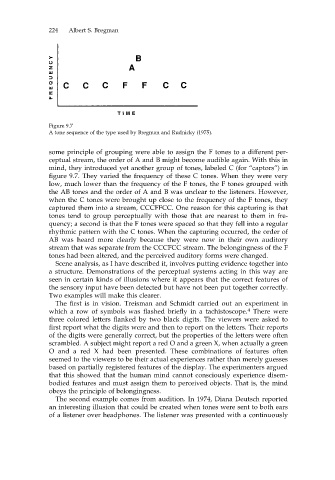
                Figure 9.7
                A tone sequence of the type used by Bregman and Rudnicky (1975).


                some principle of grouping were able to assign the F tones to a different per-
                ceptual stream, the order of A and B might become audible again. With this in
                mind, they introduced yet another group of tones, labeled C (for ‘‘captors’’) in
                figure 9.7. They varied the frequency of these C tones. When they were very
                low, much lower than the frequency of the F tones, the F tones grouped with
                the AB tones and the order of A and B was unclear to the listeners. However,
                when the C tones were brought up close to the frequency of the F tones, they
                captured them into a stream, CCCFFCC. One reason for this capturing is that
                tones tend to group perceptually with those that are nearest to them in fre-
                quency; a second is that the F tones were spaced so that they fell into a regular
                rhythmic pattern with the C tones. When the capturing occurred, the order of
                AB was heard more clearly because they were now in their own auditory
                stream that was separate from the CCCFCC stream. The belongingness of the F
                tones had been altered, and the perceived auditory forms were changed.
                  Scene analysis, as I have described it, involves putting evidence together into
                a structure. Demonstrations of the perceptual systems acting in this way are
                seen in certain kinds of illusions where it appears that the correct features of
                the sensory input have been detected but have not been put together correctly.
                Two examples will make this clearer.
                  The first is in vision. Treisman and Schmidt carried out an experiment in
                                                                           4
                which a row of symbols was flashed briefly in a tachistoscope. There were
                three colored letters flanked by two black digits. The viewers were asked to
                first report what the digits were and then to report on the letters. Their reports
                of the digits were generally correct, but the properties of the letters were often
                scrambled. A subject might report a red O and a green X, when actually a green
                O and a red X had been presented. These combinations of features often
                seemed to the viewers to be their actual experiences rather than merely guesses
                based on partially registered features of the display. The experimenters argued
                that this showed that the human mind cannot consciously experience disem-
                bodied features and must assign them to perceived objects. That is, the mind
                obeys the principle of belongingness.
                  The second example comes from audition. In 1974, Diana Deutsch reported
                an interesting illusion that could be created when tones were sent to both ears
                of a listener over headphones. The listener was presented with a continuously

