


Page 222 - Foundations of Cognitive Psychology : Core Readings
P. 222
The Auditory Scene  227


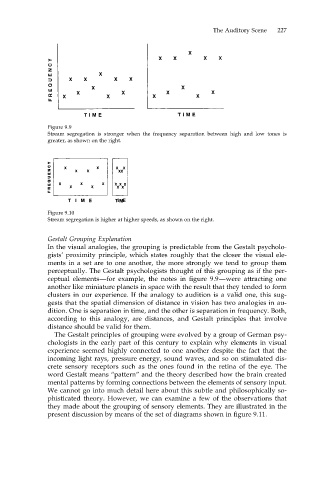
               Figure 9.9
               Stream segregation is stronger when the frequency separation between high and low tones is
               greater, as shownonthe right.


               Figure 9.10
               Stream segregation is higher at higher speeds, as shown on the right.

               Gestalt Grouping Explanation
               In the visual analogies, the grouping is predictable from the Gestalt psycholo-
               gists’ proximity principle, which states roughly that the closer the visual ele-
               ments in a set are to one another, the more strongly we tend to group them
               perceptually. The Gestalt psychologists thought of this grouping as if the per-
               ceptual elements—for example, the notes in figure 9.9—were attracting one
               another like miniature planets in space with the result that they tended to form
               clusters in our experience. If the analogy to audition is a valid one, this sug-
               gests that the spatial dimension of distance in vision has two analogies in au-
               dition. One is separation in time, and the other is separation in frequency. Both,
               according to this analogy, are distances, and Gestalt principles that involve
               distance should be valid for them.
                 The Gestalt principles of grouping were evolved by a group of German psy-
               chologists in the early part of this century to explain why elements in visual
               experience seemed highly connected to one another despite the fact that the
               incoming light rays, pressure energy, sound waves, and so on stimulated dis-
               crete sensory receptors such as the ones found in the retina of the eye. The
               word Gestalt means ‘‘pattern’’ and the theory described how the brain created
               mental patterns by forming connections between the elements of sensory input.
               We cannot go into much detail here about this subtle and philosophically so-
               phisticated theory. However, we can examine a few of the observations that
               they made about the grouping of sensory elements. They are illustrated in the
               presentdiscussion by meansofthe setofdiagramsshown in figure9.11.

