


Page 221 - Foundations of Cognitive Psychology : Core Readings
P. 221
226   Albert S. Bregman


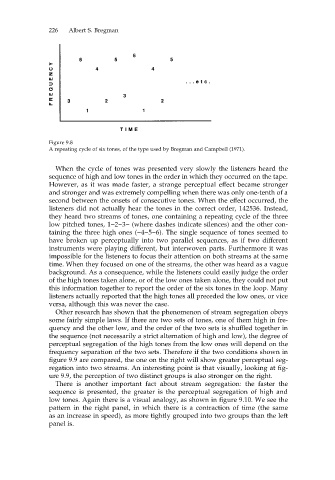
                Figure 9.8
                A repeating cycle of six tones, of the type used by Bregman and Campbell (1971).

                  When the cycle of tones was presented very slowly the listeners heard the
                sequence of high and low tones in the order in which they occurred on the tape.
                However, as it was made faster, a strange perceptual effect became stronger
                and stronger and was extremely compelling when there was only one-tenth of a
                second between the onsets of consecutive tones. When the effect occurred, the
                listeners did not actually hear the tones in the correct order, 142536. Instead,
                they heard two streams of tones, one containing a repeating cycle of the three
                low pitched tones, 1–2–3– (where dashes indicate silences) and the other con-
                taining the three high ones (–4–5–6). The single sequence of tones seemed to
                have broken up perceptually into two parallel sequences, as if two different
                instruments were playing different, but interwoven parts. Furthermore it was
                impossible for the listeners to focus their attention on both streams at the same
                time. When they focused on one of the streams, the other was heard as a vague
                background. As a consequence, while the listeners could easily judge the order
                of the high tones taken alone, or of the low ones taken alone, they could not put
                this information together to report the order of the six tones in the loop. Many
                listeners actually reported that the high tones all preceded the low ones, or vice
                versa, although this was never the case.
                  Other research has shown that the phenomenon of stream segregation obeys
                some fairly simple laws. If there are two sets of tones, one of them high in fre-
                quency and the other low, and the order of the two sets is shuffled together in
                the sequence (not necessarily a strict alternation of high and low), the degree of
                perceptual segregation of the high tones from the low ones will depend on the
                frequency separation of the two sets. Therefore if the two conditions shown in
                figure 9.9 are compared, the one on the right will show greater perceptual seg-
                regation into two streams. An interesting point is that visually, looking at fig-
                ure 9.9, the perception of two distinct groups is also stronger on the right.
                  There is another important fact about stream segregation: the faster the
                sequence is presented, the greater is the perceptual segregation of high and
                low tones. Again there is a visual analogy, as shown in figure 9.10. We see the
                pattern in the right panel, in which there is a contraction of time (the same
                as an increase in speed), as more tightly grouped into two groups than the left
                panel is.

