


Page 223 - Foundations of Cognitive Psychology : Core Readings
P. 223
228   Albert S. Bregman


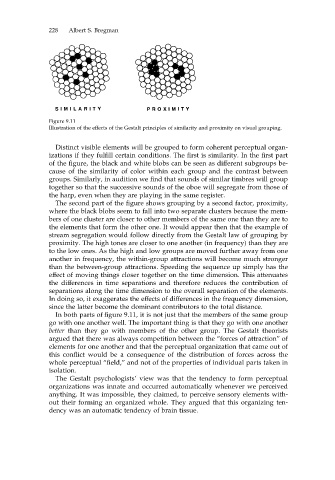
                Figure 9.11
                Illustration of the effects of the Gestalt principles of similarity and proximity on visual grouping.

                  Distinct visible elements will be grouped to form coherent perceptual organ-
                izations if they fulfill certain conditions. The first is similarity. In the first part
                of the figure, the black and white blobs can be seen as different subgroups be-
                cause of the similarity of color within each group and the contrast between
                groups. Similarly, in audition we find that sounds of similar timbres will group
                together so that the successive sounds of the oboe will segregate from those of
                the harp, even when they are playing in the same register.
                  The second part of the figure shows grouping by a second factor, proximity,
                where the black blobs seem to fall into two separate clusters because the mem-
                bers of one cluster are closer to other members of the same one than they are to
                the elements that form the other one. It would appear then that the example of
                stream segregation would follow directly from the Gestalt law of grouping by
                proximity. The high tones are closer to one another (in frequency) than they are
                to the low ones. As the high and low groups are moved further away from one
                another in frequency, the within-group attractions will become much stronger
                than the between-group attractions. Speeding the sequence up simply has the
                effect of moving things closer together on the time dimension. This attenuates
                the differences in time separations and therefore reduces the contribution of
                separations along the time dimension to the overall separation of the elements.
                In doing so, it exaggerates the effects of differences in the frequency dimension,
                since the latter become the dominant contributors to the total distance.
                  In both parts of figure 9.11, it is not just that the members of the same group
                go with one another well. The important thing is that they go with one another
                better than they go with members of the other group. The Gestalt theorists
                argued that there was always competition between the ‘‘forces of attraction’’ of
                elements for one another and that the perceptual organization that came out of
                this conflict would be a consequence of the distribution of forces across the
                whole perceptual ‘‘field,’’ and not of the properties of individual parts taken in
                isolation.
                  The Gestalt psychologists’ view was that the tendency to form perceptual
                organizations was innate and occurred automatically whenever we perceived
                anything. It was impossible, they claimed, to perceive sensory elements with-
                out their forming an organized whole. They argued that this organizing ten-
                dency was an automatic tendency of brain tissue.

