


Page 176 - From Bombay to Bollywoord The Making of a Global Media Industri
P. 176
Diasporic Entrepreneurs and Digital Media  >>  163


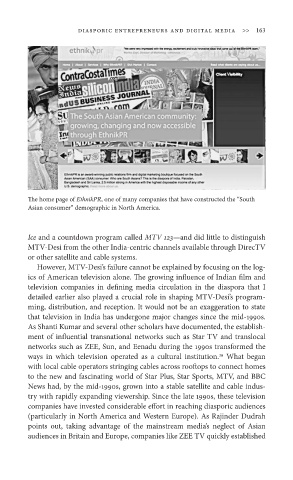
        The home page of EthnikPR, one of many companies that have constructed the “South
        Asian consumer” demographic in North America.


        Ice and a countdown program called MTV 123—and did little to distinguish
        MTV-Desi from the other India-centric channels available through DirecTV
        or other satellite and cable systems.
           However, MTV-Desi’s failure cannot be explained by focusing on the log-
        ics of American television alone. The growing influence of Indian film and
        television companies in defining media circulation in the diaspora that I
        detailed earlier also played a crucial role in shaping MTV-Desi’s program-
        ming, distribution, and reception. It would not be an exaggeration to state
        that television in India has undergone major changes since the mid-1990s.
        As Shanti Kumar and several other scholars have documented, the establish-
        ment of influential transnational networks such as Star TV and translocal
        networks such as ZEE, Sun, and Eenadu during the 1990s transformed the
        ways in which television operated as a cultural institution.  What began
                                                          29
        with local cable operators stringing cables across rooftops to connect homes
        to the new and fascinating world of Star Plus, Star Sports, MTV, and BBC
        News had, by the mid-1990s, grown into a stable satellite and cable indus-
        try with rapidly expanding viewership. Since the late 1990s, these television
        companies have invested considerable effort in reaching diasporic audiences
        (particularly in North America and Western Europe). As Rajinder Dudrah
        points out, taking advantage of the mainstream media’s neglect of Asian
        audiences in Britain and Europe, companies like ZEE TV quickly established

