


Page 177 - From Bombay to Bollywoord The Making of a Global Media Industri
P. 177
164  << Diasporic Entrepreneurs and Digital Media

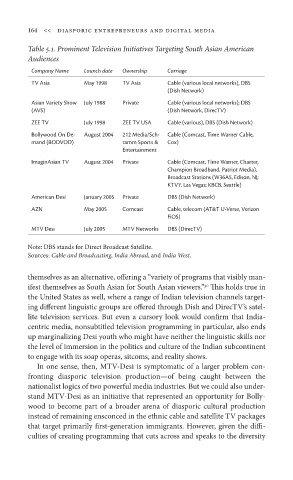
        Table 5.1. Prominent Television Initiatives Targeting South Asian American
        Audiences
         Company Name  Launch date  Ownership  Carriage
         TV Asia       May 1998  TV Asia     Cable (various local networks), DBS
                                             (Dish Network)
         Asian Variety Show   July 1988  Private  Cable (various local networks); DBS
         (AVS)                               (Dish Network, DirecTV)
         ZEE TV        July 1998  ZEE TV USA  Cable (various), DBS (Dish Network)
         Bollywood On De-  August 2004  212 Media/Sch-  Cable (Comcast, Time Warner Cable,
         mand (BODVOD)           ramm Sports &   Cox)
                                 Entertainment
         ImaginAsian TV  August 2004  Private  Cable (Comcast, Time Warner, Charter,
                                             Champion Broadband, Patriot Media),
                                             Broadcast Stations (W36AS, Edison, NJ;
                                             KTVY, Las Vegas; KBCB, Seattle)
         American Desi  January 2005  Private  DBS (Dish Network)
         AZN           May 2005  Comcast     Cable, telecom (AT&T U-Verse, Verizon
                                             FiOS)
         MTV Desi      July 2005  MTV Networks  DBS (DirecTV)

        Note: DBS stands for Direct Broadcast Satellite.
        Sources: Cable and Broadcasting, India Abroad, and India West.


        themselves as an alternative, offering a “variety of programs that visibly man-
                                                       30
        ifest themselves as South Asian for South Asian viewers.”  This holds true in
        the United States as well, where a range of Indian television channels target-
        ing different linguistic groups are offered through Dish and DirecTV’s satel-
        lite television services. But even a cursory look would confirm that India-
        centric media, nonsubtitled television programming in particular, also ends
        up marginalizing Desi youth who might have neither the linguistic skills nor
        the level of immersion in the politics and culture of the Indian subcontinent
        to engage with its soap operas, sitcoms, and reality shows.
           In one sense, then, MTV-Desi is symptomatic of a larger problem con-
        fronting diasporic television production—of being caught between the
        nationalist logics of two powerful media industries. But we could also under-
        stand MTV-Desi as an initiative that represented an opportunity for Bolly-
        wood to become part of a broader arena of diasporic cultural production
        instead of remaining ensconced in the ethnic cable and satellite TV packages
        that target primarily first-generation immigrants. However, given the diffi-
        culties of creating programming that cuts across and speaks to the diversity

