


Page 175 - Fundamentals of Communications Systems
P. 175
Analog Communications Basics  5.15

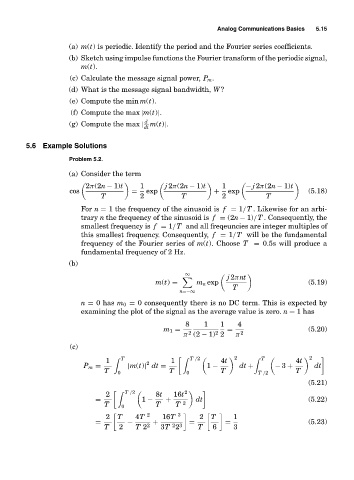
                      (a) m(t) is periodic. Identify the period and the Fourier series coefficients.
                      (b) Sketch using impulse functions the Fourier transform of the periodic signal,
                          m(t).
                       (c) Calculate the message signal power, P m .
                      (d) What is the message signal bandwidth, W?
                      (e) Compute the min m(t).
                       (f) Compute the max |m(t)|.
                                           d
                      (g) Compute the max | m(t)|.
                                           dt
          5.6 Example Solutions
                      Problem 5.2.

                      (a) Consider the term
                           2π(2n − 1)t    1      j 2π(2n − 1)t   1     − j 2π(2n − 1)t

                      cos               =   exp                +   exp                   (5.18)
                               T          2           T          2           T
                          For n = 1 the frequency of the sinusoid is f = 1/T . Likewise for an arbi-
                          trary n the frequency of the sinusoid is f = (2n − 1)/T . Consequently, the
                          smallest frequency is f = 1/T and all freqeuncies are integer multiples of
                          this smallest frequency. Consequently, f = 1/T will be the fundamental
                          frequency of the Fourier series of m(t). Choose T = 0.5s will produce a
                          fundamental frequency of 2 Hz.
                      (b)

                                                       ∞
                                                                  j 2πnt
                                              m(t) =      m n exp                        (5.19)
                                                                    T
                                                     n=−∞
                          n = 0 has m 0 = 0 consequently there is no DC term. This is expected by
                          examining the plot of the signal as the average value is zero. n = 1 has
                                                       8    1   1    4
                                                 m 1 =            =                      (5.20)
                                                       2
                                                               2
                                                      π (2 − 1) 2    π 2
                       (c)
                                 1     T    2      1  	    T /2     4t    2     T     4t    2
                          P m =        |m(t)| dt =           1 −      dt +      − 3 +      dt
                                T   0             T    0        T          T /2      T
                                                                                         (5.21)
                                 2  	    T /2     8t  16t 2
                              =            1 −   +    2   dt                             (5.22)
                                T    0        T     T
                                 2  	  T  4T  2  16T  3
  2  	  T
  1
                              =       −       +         =         =                      (5.23)
                                                   2 3
                                T   2    T 2 2  3T 2      T   6     3

