


Page 517 - Fundamentals of Radar Signal Processing
P. 517
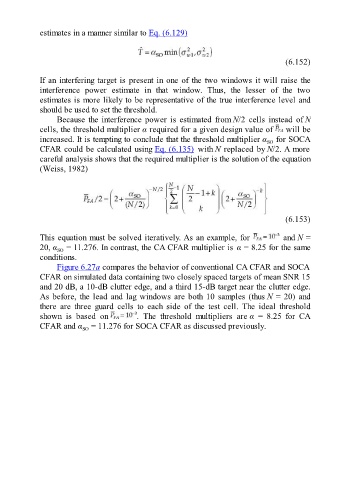
estimates in a manner similar to Eq. (6.129)


                                                                                                     (6.152)

               If an interfering target is present in one of the two windows it will raise the
               interference  power  estimate  in  that  window.  Thus,  the  lesser  of  the  two
               estimates is more likely to be representative of the true interference level and
               should be used to set the threshold.

                     Because the interference power is estimated from N/2  cells  instead  of N
               cells, the threshold multiplier α required for a given design value of   will be
               increased. It is tempting to conclude that the threshold multiplier α  for SOCA
                                                                                               SO
               CFAR could be calculated using Eq. (6.135)  with N replaced by N/2. A more
               careful analysis shows that the required multiplier is the solution of the equation
               (Weiss, 1982)


                                                                                                     (6.153)


               This equation must be solved iteratively. As an example, for                          and N =

               20, α  = 11.276. In contrast, the CA CFAR multiplier is α = 8.25 for the same
                     SO
               conditions.
                     Figure 6.27a compares the behavior of conventional CA CFAR and SOCA
               CFAR on simulated data containing two closely spaced targets of mean SNR 15
               and 20 dB, a 10-dB clutter edge, and a third 15-dB target near the clutter edge.
               As before, the lead and lag windows are both 10 samples (thus N = 20) and
               there  are  three  guard  cells  to  each  side  of  the  test  cell.  The  ideal  threshold

               shown  is  based  on              .  The  threshold  multipliers  are α  =  8.25  for  CA
               CFAR and α  = 11.276 for SOCA CFAR as discussed previously.
                              SO

