


Page 165 - Gas Purification 5E
P. 165
Alkanolamines for Hydrogen Sulfide and Carbon Dioxide Removal   153


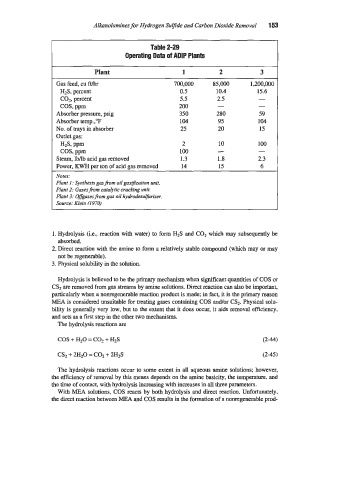
                                              Table 2-29
                                      Operating Data of ADlP Plants

                             Plant                     1          2           3
                  Gas feed, cu ft/hr                 700,000    85,000     1,200,000
                   H2S, percent                        0.5       10.4        15.6
                   CO?, percent                        5.5        2.5         -
                   COS, ppm                           200         -           -
                  Absorber pressure, psig             350        280          59
                  Absorber temp.,’F                   104         95          104
                  No. of trays in absorber             25         20          15
                  Outlet gas:
                                                                  10
                   HIS, PPm                            2          -           100
                   COS, ppm                           100                     -
                  Steam, lbflb acid gas removed        1.3        1.8         2.3
                  Power, KWH per ton of acid gas removed   14     15          6
                  .votes:
                  Plant I: Synthesis gas from oil gasiycation unit.
                  Plant 2: Gasesfrom catalytic cracking unit.
                  Plant 3: Offgases from gas oil hydi-odesuljimker.
                  Source: Klein f1970)


                 1. Hydrolysis (i.e.:  reaction with water) to form HIS and COI which may  subsequently be
                  absorbed.
                 2. Direct reaction with the amine to form a relatively  stable compound (which may or may
                  not be regenerable).
                 3. Physical solubility in the solution.

                  Hydrolysis is believed to be the primary mechanism when significant quantities of COS or
                 CS2 are removed from gas streams by amine solutions. Direct reaction can also be important,
                particularly when a nonregenerable reaction product is made; in fact, it is the primary reason
                MEA is considered unsuitable for treating gases containing COS andor CS2. Physical solu-
                bility is generally very low, but to the extent that it does occur, it aids removal efficiency.
                 and acts as a first step in the other two mechanisms.
                  The hydrolysis reactions are
                  COS + H20 = CO, + H2S                                        (2-444)

                  CSI + 2H20 = COZ + 2HzS                                      (2-45)

                  The hydrolysis reactions  occur to some extent in all aqueous amine solutions; however,
                the efficiency of removal by this means depends on the amine basicity, the temperature. and
                the time of contact, with hydrolysis increasing with increases in all three parameters.
                  With MEA solutions, COS reacts by both hydrolysis and direct reaction.  Unfortunately,
                the direct reaction between MEA and COS results in the formation of a nonregenerable prod-

