


Page 160 - Gas Purification 5E
P. 160
148    Gas PuriJication


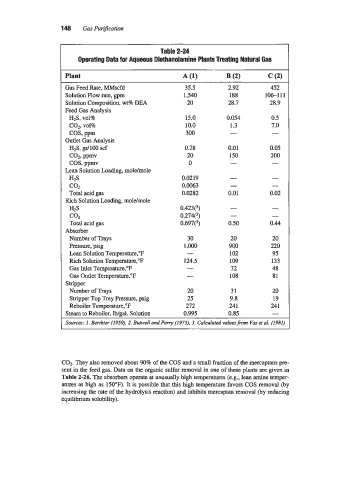
                                                Table 2-24
                        Operating Data for Aqueous Diethanolamine Plants Treating Natural Gas


                    Gas Feed Rate, MMscfd               35.5        2.92         452
                    Solution Flow rate, gpm            1,540         188       1061 11
                    Solution Composition, wt8 DEA       20          28.7         28.9
                    Feed Gas Analysis
                     HzS, ~01%                          15.0        0.054        0.5
                      co2, YO19                         10.0         1.3         7.0
                      COS, ppm                          300          -           -
                    Outlet Gas Analysis
                      HIS, gr/lOO scf                   0.28        0.01         0.05
                      C02, ppmv                         20           150         200
                      COS, ppmv                          0           -           -
                    Lean Solution Loading, mole/mole
                      H2S                              0.0219        -           -
                      coz                              0.0063        -           -
                      Total acid gas                   0.0282       0.01         0.02
                    Rich Solution Loading, moldmole
                      H2S                             0.423(3)       -           -
                      coz                             0.274(3)       -           -
                      Total acid gas                  0.697(3)      0.50         0.44
                    Absorber
                      Number of Trays                   30           20          20
                      Pressure, psig                   1,000         900         220
                      Lean Solution Temperature,"F      -            102         95
                      Rich Solution Temperature,"F     124.5         109         133
                      Gas Inlet Temperature,"F          -            72          48
                      Gas Outlet Temperature,"F         -            108          81
                    Stripper
                      Number of Trays                   20           31           20
                      Stripper Top Tray Pressure, psig   25          9.8          19
                      Reboiler Temperature,"F           272          241         24 1
                    Steam to Reboiler, lbkal. Solution   0.995       0.85        -
                    Sources: 1. Berthier (1959). 2. Butwell and Perry (1975). 3. Calculated valuesfrom Vaz et al. (1981)


                   C02. They also removed about 90% of the COS and a small fraction of the mercaptans pre-
                   sent in the feed gas. Data on the organic sulfur removal in one of these plants are given in
                   Table 2-26. The absorbers operate at unusually high temperatures (e.g., lean amine temper-
                   atures as high as 150°F). It is possible that this high temperature favors COS removal (by
                   increasing the rate of the hydrolysis reaction) and inhibits mercaptan removal (by reducing
                   equilibrium solubility).

